管
Character Story & Explanation
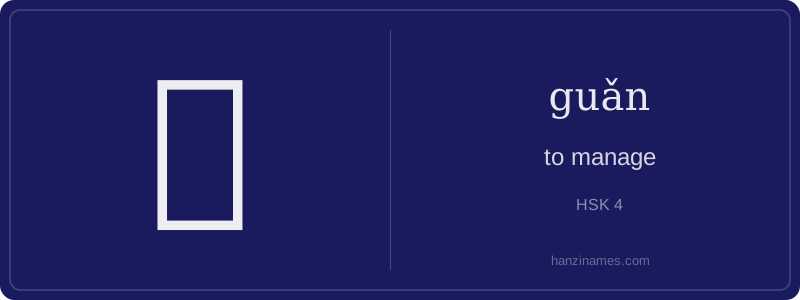
管 appears frequently in modern Chinese life: in workplaces (经理管项目 — manager oversees the project), schools (老师管纪律 — teacher manages discipline), and family contexts (奶奶管做饭 — grandma handles cooking). A well-documented idiom is 不管三七二十一 (bù guǎn sān qī èr shí yī), meaning ‘regardless of consequences’, widely attested in 20th-century literature and still used today. Historically, 管 was used in classical texts like the *Zuo Zhuan* to denote administrative oversight by feudal officials.
The character’s earliest form (in bronze inscriptions, c. 1000 BCE) depicts a bamboo tube with a stopper — clearly pictographic. The top ⺮ represents bamboo; the bottom 官 (guān) originally meant ‘official in charge’, later simplified to 官-like structure (+厶). So 管 literally meant ‘an official’s bamboo tube’ — possibly a ceremonial scepter or seal case — symbolizing delegated authority.
Hi students! Let’s explore 管 (guǎn), a Level 4 HSK character with 14 strokes and the bamboo radical ⺮. Though it literally meant ‘bamboo tube’ in ancient times, its core modern meaning is ‘to take care of’, ‘to manage’, or ‘to be responsible for’. Think of it as gentle authority — not bossing, but guiding and overseeing, like a teacher managing a class or a parent caring for children.
The bamboo radical hints at its origin: early pipes and flutes were made from bamboo, and ‘tube’ evolved metaphorically into ‘channel of control’ — just as water flows through a pipe, responsibility flows through a person in charge. This shift from physical object to abstract action is common in Chinese characters and shows how language reflects cultural thinking about structure and duty.
Don’t confuse 管 with verbs like 做 (to do) or 负责 (to be responsible for) — 管 carries a sense of ongoing, hands-on involvement. It’s often used in daily speech with objects (e.g., 管孩子 — to take care of children) or in set phrases like 不管 (bù guǎn — ‘regardless of’). Its tone is neutral-to-authoritative, never harsh — more ‘I’ll handle it’ than ‘I command you’.
Example Sentences
Common Compounds
Similar Characters — Don't Mix These Up
Your First Step into Chinese Culture: Get a Chinese Name
Every journey into Chinese begins with a name. Use our free Chinese name generator to create a meaningful, personalized Chinese name that fits you perfectly.
Get My Chinese Name →