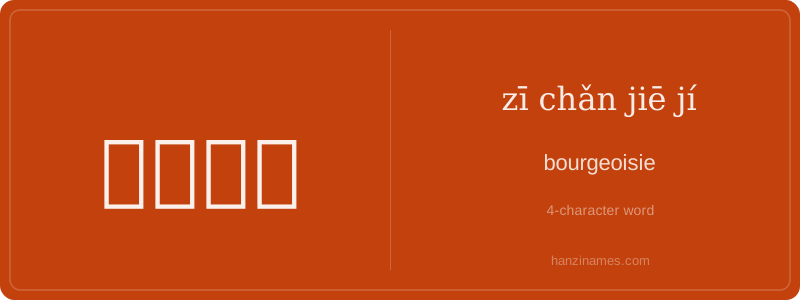
资产阶级
How to Say
👀 0
How to Write
Meaning: bourgeoisie
How to Understand
资产阶级
资产阶级 refers to the bourgeoisie, a social class that owns the means of production and derives income from the exploitation of wage labor. It is a key term in Marxist theory, distinguishing it from the proletariat, who sell their labor for wages.
The character 资 (zī) means 'resources' or 'capital,' 产 (chǎn) means 'production' or 'property,' 阶 (jiē) means 'class' or 'level,' and 级 (jí) means 'rank' or 'grade.' Together, they form a term that describes a class based on ownership of capital and property.
In modern Chinese political discourse, 资产阶级 is often used in discussions about economic inequality and class struggle. It is commonly encountered in historical and sociopolitical contexts, especially in educational materials and academic texts.
Example Sentences
资本家属于资产阶级,他们通过投资获取利润。
The capitalists belong to the bourgeoisie, who gain profits through investments.
在革命时期,无产阶级与资产阶级之间的矛盾尤为突出。
During the revolutionary period, the contradictions between the proletariat and the bourgeoisie were particularly prominent.