阶
Character Story & Explanation
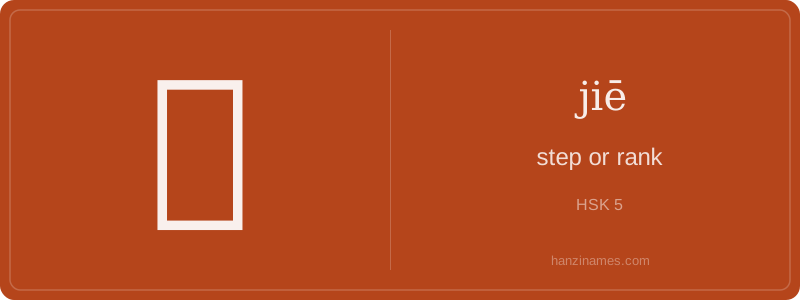
阶 is widely used in modern Chinese administrative, educational, and technical domains. It appears in standardized terms like '初级职称' (chūjí zhíchēng, junior professional title), '高级工程师' (gāojí gōngchéngshī, senior engineer), and '阶级斗争' (jiējí dòuzhēng, class struggle)—a phrase institutionalized during the Mao era and still referenced in political education. The term '台阶' (táijiē, step/stair) remains common in daily speech and urban signage.
Historically, 阶 evolved from the ancient character 陛 (bì), referring to the steps leading to an emperor’s throne—symbolizing proximity to power and hierarchical access. Though its earliest form isn’t a pictograph, the modern 阶 (with the 'hill' radical 阝 on the right) was standardized in the Han dynasty clerical script and later simplified. Today, Chinese people encounter it routinely on job application forms, civil service exam notices, and university promotion announcements—never as archaic, but as living bureaucratic vocabulary.
The Chinese character 阶 (jiē) literally denotes a physical step or stair, but its core semantic extension is 'rank' or 'level'—a metaphor deeply embedded in Chinese social and bureaucratic thought. Unlike Western notions of rank that often emphasize individual achievement or title (e.g., 'captain', 'professor'), 阶 reflects a systemic, hierarchical positioning within an ordered structure—be it civil service grades, academic promotions, or even stages of moral cultivation in Confucian tradition.
This character appears frequently in formal and institutional contexts: government documents list official ranks as '行政级别' (hángzhèng jíbié), where 阶 is implicit in jí (level); '阶级' (jiējí, class) carries historical weight from Marxist theory adapted into Chinese political discourse. Its abstraction from architecture to social order mirrors how Chinese conceptual metaphors often ground abstract ideas in tangible, spatial experience—much like English 'stepping up' or 'climbing the ladder', though 阶 implies less agency and more structural placement.
In contrast to Western meritocratic ideals that valorize horizontal mobility ('breaking the glass ceiling'), 阶 evokes vertical stratification with prescribed pathways—advancement requires not just competence but adherence to procedural norms, seniority, and collective recognition. This resonates with traditional values like rén (benevolence) and lǐ (ritual propriety), where one’s position defines relational duties. Thus, 阶 is never neutral: it signals responsibility, expectation, and embeddedness—not just status, but situatedness.
Example Sentences
Common Compounds
Similar Characters — Don't Mix These Up
Your First Step into Chinese Culture: Get a Chinese Name
Every journey into Chinese begins with a name. Use our free Chinese name generator to create a meaningful, personalized Chinese name that fits you perfectly.
Get My Chinese Name →