陆
Character Story & Explanation
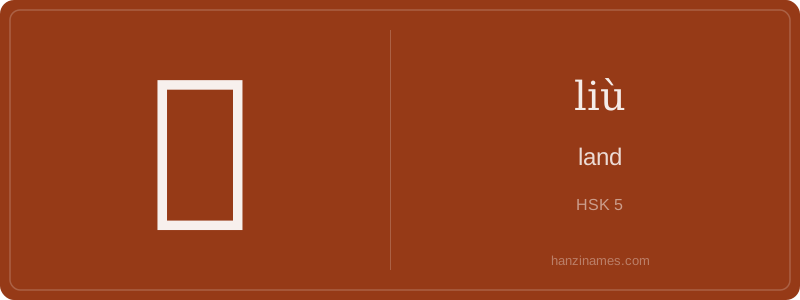
陆 is widely used in contemporary Chinese for geographical and administrative terms: 陆地 (lù dì, 'land/continent'), 陆军 (lù jūn, 'army'), and 陆运 (lù yùn, 'land transport'). It appears in the official name of China’s land border agency (国家移民管理局陆地边防处) and is central to the phrase 中国大陆, a term codified in PRC state media since the 1950s to distinguish mainland territory from Taiwan and islands. The character also features in the surname 陆, borne by over 4 million people in China (2020 MPS data).
The character 陆 is a phono-semantic compound: the left component 甫 (fǔ, archaic meaning 'beginning') provides approximate pronunciation, while the right radical 阝 ('mound' or 'settlement') signals its connection to land. It first appeared in bronze inscriptions of the Western Zhou dynasty (c. 1046–771 BCE) with meanings related to 'to arrive on land' or 'shore', later standardizing to 'land' during the Qin small seal script era.
The Chinese character 陆 is pronounced lù in most contexts—not liù—and is frequently misread by learners due to its visual similarity to the number six (六, liù). While 陆 does not mean 'six', it is a common surname (e.g., Lu Xun) and denotes 'land' or 'mainland', especially in geopolitical terms like 中国大陆 (lù dì zhōng guó, 'Mainland China'). Its radical 阝 (right ear radical) historically relates to settlements or terrain, anchoring its meaning in geography rather than numerals.
Unlike Western numerals, which are purely abstract symbols (e.g., '6' derived from Latin 'sex'), Chinese number characters like 六 (liù) evolved from tally marks and are phonosemantic compounds. 陆 (lù), though homophonic with liù in some dialects, belongs to a different semantic field entirely—its core function is topographic. Confusing 陆 with 六 is one of the most frequent beginner errors, underscoring how critical tone and context are in Mandarin literacy.
Culturally, 陆 evokes territorial sovereignty and connectivity: as in 陆路 (lù lù, 'overland route'), it reflects China’s historical reliance on land-based trade (e.g., the Silk Road), contrasting with maritime-focused civilizations like ancient Greece or Phoenicia. In modern usage, 陆 appears in official terminology distinguishing land territory from maritime or air domains—mirroring Western legal concepts like 'terra firma' or 'dry land', but embedded in bureaucratic and cartographic language far more pervasively than English equivalents.
Example Sentences
Common Compounds
Similar Characters — Don't Mix These Up
Your First Step into Chinese Culture: Get a Chinese Name
Every journey into Chinese begins with a name. Use our free Chinese name generator to create a meaningful, personalized Chinese name that fits you perfectly.
Get My Chinese Name →