另一方面
How to Understand
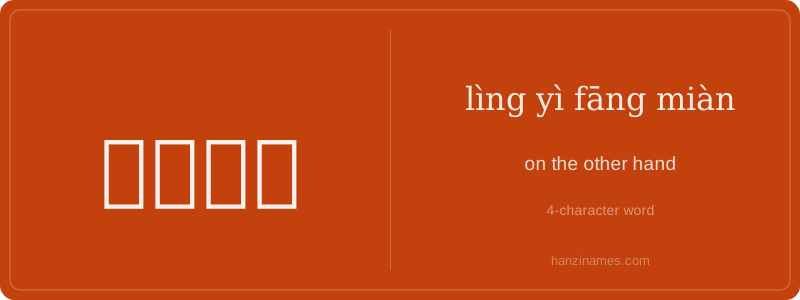
"另一方面" is an adverbial phrase used to introduce an alternative perspective, contrast, or additional point of view in a discussion. It is commonly used in both spoken and written Chinese to present another side of an argument or situation.
The word breaks down into four characters: 另 (lìng) meaning 'other' or 'another', 一 (yī) meaning 'one', 方 (fāng) meaning 'side' or 'direction', and 面 (miàn) meaning 'face' or 'aspect'. Together, they form a phrase that literally translates to 'another side' or 'another aspect', but is more naturally translated as 'on the other hand' in English.
This expression is widely used in academic, formal, and casual contexts to compare different viewpoints or highlight opposing ideas. It is similar to phrases like 'however' or 'in contrast' in English and is essential for constructing balanced arguments or narratives in Chinese.