另
Character Story & Explanation
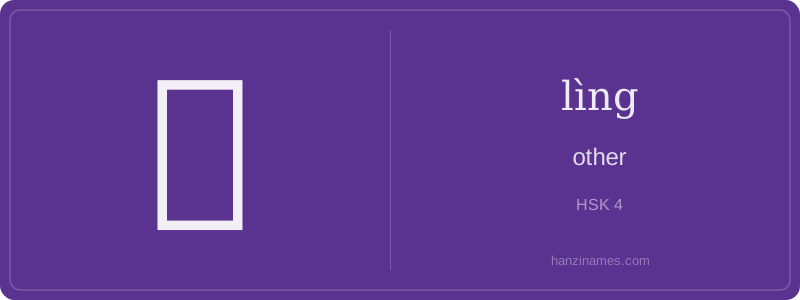
In daily life, 另 appears constantly in written Chinese: on signs ('另请排队' — 'Please queue separately'), in digital interfaces ('另存为' — 'Save As'), and in formal speech ('另作安排' — 'make alternative arrangements'). It's indispensable in bureaucracy and computing — HSK 4 learners encounter it in emails, forms, and instructions. Historically, its earliest verified usage dates to Tang-dynasty Dunhuang manuscripts, where it consistently marks divergent clauses or alternate procedures.
The character has no pictographic origin — it’s a phono-semantic compound derived from 令 (lìng), with 口 serving as a classifying radical for 'utterance-based distinction', not 'mouth'. Its form stabilized during the regular script standardization of the Tang, and today, Chinese learners practice its stroke order rigorously: 一 丿 丨 丶 — a sequence emphasizing separation and finality.
Our detective begins at the crime scene: the character 另, five strokes, radical 口. At first glance, it seems odd—why does 'other' carry a mouth radical? But the clue lies not in speech, but in function: 口 here acts as a semantic frame for *distinct categories*, much like how 古 (ancient) or 各 (each) use 口 to mark conceptual boundaries—not phonetics. Early clerical script forms show 另 evolving from a simplified variant of 令 (to order), suggesting an original sense of 'a separate command' or 'alternative directive'.
Zooming in on the brushwork: the top stroke is a short horizontal (一), followed by a descending diagonal (丿), then the defining 'box-and-dot' — a compressed 口 with a dot inside (⺊). That dot isn’t decorative; it’s the critical forensic detail distinguishing 另 from other 口-structured characters. It signals differentiation — a marked departure, a new instance. This dot became standardized by the Tang dynasty, cementing 另’s role as the go-to character for 'another' or 'separate' in bureaucratic and literary texts.
Forensic linguistics confirms no oracle bone or bronze script precursors exist for 另 — it’s a later Han-to-Tang innovation, born from practical writing needs. Scribes needed a concise, unambiguous way to denote 'not this one, but another'. Rather than borrowing homophones like 令 (lìng), they created 另: a functional glyph designed for clarity, not pictorial representation. Its clean structure—five strokes, high frequency, low ambiguity—made it ideal for administrative documents, poetry, and eventually modern Mandarin, where it anchors dozens of essential compounds.
Example Sentences
Common Compounds
Similar Characters — Don't Mix These Up
Your First Step into Chinese Culture: Get a Chinese Name
Every journey into Chinese begins with a name. Use our free Chinese name generator to create a meaningful, personalized Chinese name that fits you perfectly.
Get My Chinese Name →