秒
Character Story & Explanation
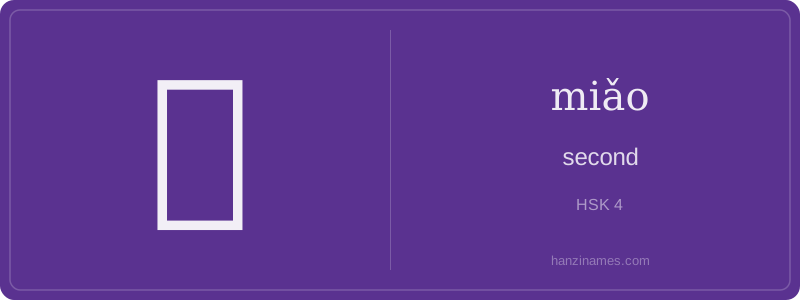
秒 is ubiquitous in contemporary Chinese life: digital clocks, fitness apps, railway station departure boards, and live broadcast timestamps all use it unambiguously for 'second'. It appears in standardized phrases like 倒计时三秒 (dào jìshí sān miǎo, 'three-second countdown'), widely used in national events like the Spring Festival Gala and space launch broadcasts. The idiom 争分夺秒 (zhēng fēn duó miǎo) is codified in textbooks and official media to express urgent productivity—reflecting societal emphasis on efficiency.
Graphically, 秒 is a phono-semantic compound: 禾 (hé, grain radical) provides semantic association with ancient agricultural calendars tied to precise timekeeping, while 少 (shǎo, 'few') indicates pronunciation (miǎo evolved from *shǎo via tonal shift and historical sound change). This structure is documented in the *Shuōwén Jiězì* (121 CE), where 秒 is defined as 'a minute division of degree or time', confirming its technical, not pictographic, origin.
The Chinese character 秒 (miǎo) primarily denotes the unit of time 'second'—one sixtieth of a minute—and is fundamental in modern timekeeping, digital interfaces, and scientific measurement. Unlike English, where 'second' also functions as an ordinal number (e.g., 'the second person'), 秒 is strictly temporal in standard usage; ordinals are expressed with 第二 (dì èr). Its inclusion in HSK Level 4 reflects its high-frequency role in daily communication, from countdown timers to sports results and live-streamed events.
Etymologically, 秒 belongs to the 禾 (grain/plant) radical—a seemingly unexpected choice for a time unit. Historically, it originated as a unit of angular or astronomical measurement in ancient Chinese mathematics and calendrical science, where one 'second' was 1/100th of a 'degree' (度), later adapted to time. This precision-oriented origin aligns with China’s long tradition of astronomical observation, documented in texts like the Tang dynasty’s *Dayan Calendar*.
Culturally, 秒 carries connotations of brevity and urgency absent in Western equivalents. Phrases like 争分夺秒 (zhēng fēn duó miǎo, 'compete for minutes and seize seconds') underscore how milliseconds matter in exams, emergency response, or e-commerce flash sales—echoing global digital acceleration but with distinct linguistic framing. Unlike English, where 'a second' can imply hesitation ('Wait a second!'), 秒 rarely serves as a discourse marker; instead, 一下 (yí xià) fills that pragmatic role.
Example Sentences
Common Compounds
Similar Characters — Don't Mix These Up
Your First Step into Chinese Culture: Get a Chinese Name
Every journey into Chinese begins with a name. Use our free Chinese name generator to create a meaningful, personalized Chinese name that fits you perfectly.
Get My Chinese Name →