科
Character Story & Explanation
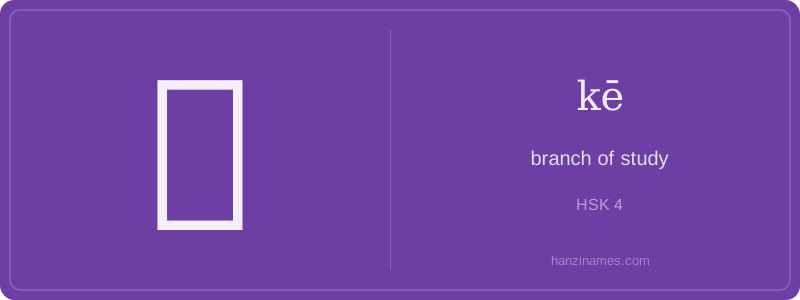
In daily life, 科 appears ubiquitously: university departments (历史科 lìshǐ kē, 'History Department'), school subjects (数学课 shùxué kè — note the variant reading kè in compound with 课), and scientific fields (生物学 kēxué, 'biology'). It’s central to China’s civil service exam history (keju system), where candidates were sorted into examination 'branches' (科), such as 进士科 jìnshì kē ('Jinshi Degree Branch'). The term 科技 (kējì, 'science and technology') is a pillar of national policy and public discourse.
The character’s earliest attested form appears in Han dynasty clerical script, combining 禾 and 料 — not an oracle-bone pictograph, but a phono-semantic compound. Its structure has remained stable for over 2,000 years, reflecting how deeply institutionalized 'categorized knowledge' became in Chinese bureaucratic and scholarly culture.
Our detective work begins with the radical 禾 (hé) — the 'grain' or 'cereal' component — which appears at the left. Historically, this radical often relates to agriculture, growth, or things measured and categorized, hinting at early associations with systematic classification. Though 科 no longer means 'grain', its placement signals that ancient Chinese linked knowledge domains to orderly, harvest-like cultivation of understanding.
The right side, 料 (liào), is a phonetic component (though simplified in modern form to 斗 + ⺅), originally meaning 'to measure' or 'to estimate'. In classical texts, 料 was used for assessing grain yields — a precise, quantitative act. This reinforces 科’s core idea: a branch of study isn’t vague curiosity, but a measured, classified, and methodologically grounded field — like measuring a harvest of ideas.
Over centuries, 科 evolved from concrete measurement to abstract categorization. By the Tang and Song dynasties, it denoted official examination categories (e.g., 明經科 míngjīng kē, 'Classics Examination Division') — institutionalized branches of scholarly pursuit. Today, it carries that legacy: every 'science' (kēxué), 'department' (kē), or 'subject' (kēmù) reflects this enduring logic of disciplined, structured inquiry.
Example Sentences
Common Compounds
Similar Characters — Don't Mix These Up
Your First Step into Chinese Culture: Get a Chinese Name
Every journey into Chinese begins with a name. Use our free Chinese name generator to create a meaningful, personalized Chinese name that fits you perfectly.
Get My Chinese Name →