程
Character Story & Explanation
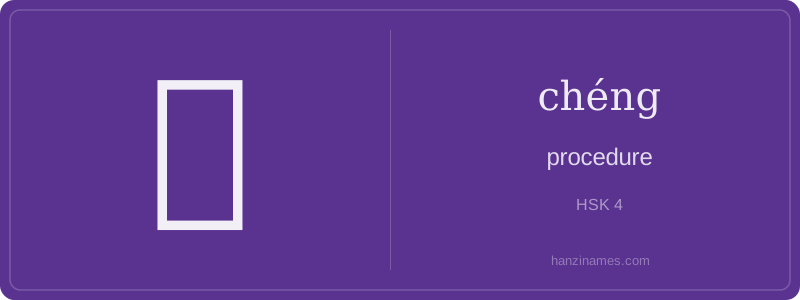
In modern Chinese, 程 is ubiquitous in institutional and technical contexts: 学程 (xuéchéng, academic program), 工程 (gōngchéng, engineering project), and 课程 (kèchéng, curriculum). It appears in the official name of China’s lunar exploration program, 嫦娥工程 (Cháng’é Gōngchéng), and in the national standardization system (国家标准, guójiā biāozhǔn), where 程 implies rigorously defined processes. A key idiom is 按部就班 (ànbùjiùbān)—‘follow step-by-step procedure’—with 程 embedded in the concept of orderly progression.
The character’s earliest attested form appears in seal script (c. 3rd century BCE), combining 禾 (grain) and 呈 (to present). While no oracle bone form survives, bronze inscriptions confirm its use in Zhou-era administrative records for grain quotas and ritual schedules—verifiably tied to standardized measurement and reporting, not mythical or pictographic origins.
Unearthing 程 (chéng) is like brushing dust from a Zhou dynasty bronze inscription—what first appears as 'rule' reveals deeper strata of meaning. Its radical 禾 (grain, agriculture) hints at ancient origins in land measurement and harvest cycles: early states codified seasonal rites, field boundaries, and tax quotas into standardized procedures—precisely what 程 denoted: an authoritative, repeatable standard.
By the Warring States period, 程 evolved beyond agrarian metrics to encompass procedural norms—military drills, bureaucratic protocols, even philosophical standards of conduct. The character’s right-hand component 呈 (to present, submit) reinforces its function as a formalized benchmark offered to authority. This duality—measurable standard + sanctioned presentation—anchors its semantic core across millennia.
Crucially, 程 never meant rigid law (like 法 fǎ) but rather the calibrated, time-tested method—the ‘course’ or ‘procedure’ that ensures consistency. In Han legal texts, 程 often appears alongside 量 (measure) and 限 (limit), confirming its role in quantifiable governance. Even today, its resonance lies not in prohibition, but in reliable, stepwise execution—making it indispensable for systems, from exams to engineering.
Example Sentences
Common Compounds
Similar Characters — Don't Mix These Up
Your First Step into Chinese Culture: Get a Chinese Name
Every journey into Chinese begins with a name. Use our free Chinese name generator to create a meaningful, personalized Chinese name that fits you perfectly.
Get My Chinese Name →