穷
Character Story & Explanation
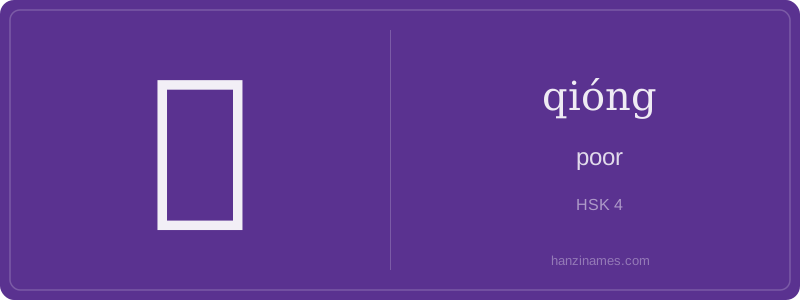
In contemporary China, 穷 most commonly appears in official and media discourse around poverty alleviation — notably in the national campaign '精准扶贫' (jīngzhǔn fúpín, 'targeted poverty alleviation'), launched in 2013 and widely documented by the World Bank and China’s State Council. It also features in idioms like '穷则思变' (qióng zé sī biàn, 'When impoverished, one seeks change'), cited in the ancient text *The Book of Changes* (*Yìjīng*), reflecting a longstanding cultural view of scarcity as a catalyst for innovation.
The character’s form is not pictographic but phono-semantic: the radical 穴 (xué, 'cave') indicates a category related to dwellings or containment, while the phonetic component 茕 (qióng) — originally meaning 'alone, solitary' — provides sound and conceptual resonance. No oracle-bone or bronze script form survives; its earliest attested form appears in seal script (c. 3rd century BCE), already bearing its modern structure.
The character 穷 (qióng) evokes the quiet resilience of everyday life in China’s rapidly transforming cities and countryside. Historically tied to material scarcity, it now carries layered meanings — from economic hardship to intellectual or emotional exhaustion. Its radical 穴 (cave) hints at confinement or limitation, while the phonetic component 茕 (a variant of 茕, meaning 'solitary') reinforces isolation. In modern usage, it rarely stands alone as a blunt label for poverty but appears in compound words that reflect systemic, temporary, or metaphorical lack.
Unlike Western binary notions of 'rich vs. poor', 穷 often implies relativity and transience — someone may be 穷 in cash but rich in relationships or knowledge. Government reports, news headlines, and social media discussions use it with nuance: e.g., '脱贫' (tuōpín, 'poverty alleviation') reflects China’s historic campaign to lift over 100 million people out of absolute poverty by 2020. This context reshapes how younger generations perceive the character — not as stigma, but as a marker of past struggle and collective progress.
Visually, 穷 is compact yet expressive: seven strokes forming a structure where the cave radical frames the upper part, suggesting shelter or constraint, while the lower component conveys emptiness or depletion. Its HSK Level 4 status signals that learners encounter it early in intermediate study — not just as vocabulary, but as a cultural lens into values like frugality (节俭), perseverance (坚持), and the Confucian ideal of 'poverty without baseness' (贫而无谄). Mastery unlocks richer reading of policy texts, literature, and daily conversation.
Example Sentences
Common Compounds
Similar Characters — Don't Mix These Up
Your First Step into Chinese Culture: Get a Chinese Name
Every journey into Chinese begins with a name. Use our free Chinese name generator to create a meaningful, personalized Chinese name that fits you perfectly.
Get My Chinese Name →