竞
Character Story & Explanation
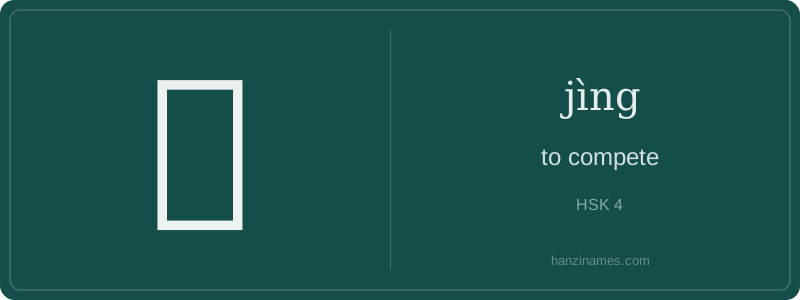
竞 is ubiquitous in modern Chinese: from job application forms (竞聘, jìngpìn, 'competitive recruitment') to Olympic broadcasts (竞技, jìngjì, 'athletic competition'). It appears in the national curriculum (HSK 4), official documents, and headlines like '激烈竞争' (jīliè jìngzhēng, 'fierce competition'). The idiom '明争暗竞' (míng zhēng àn jìng) — 'open contention and covert competition' — reflects its dual role in social dynamics.
The character’s earliest confirmed form is in Warring States bronze inscriptions and Qin bamboo texts. Though its origin isn’t pictographic, scholars agree the doubled 可 likely represents phonetic reinforcement (a common practice in ancient Chinese script formation), not literal 'two possibilities'. Its consistent use in bureaucratic and military records confirms its early association with formalized, rule-bound rivalry—not spontaneous conflict.
As an archaeologist brushing dust from a Han dynasty bamboo slip, I find 竜—no, wait—*竞*—emerging not as a static glyph but as kinetic energy frozen in ink. Its top half, 立 (lì, 'to stand'), anchors the character like a starting line; beneath it, the doubled 可 (kě) is not repetition but rhythmic doubling—suggesting synchronized motion, two bodies straining forward in unison. This isn’t passive observation: it’s the visual fossil of human striving, etched into calligraphy and legal texts alike.
The character first appears reliably in seal script during the Warring States period (475–221 BCE), where its structure already conveys mutual effort—not rivalry as hostility, but *structured contest*. Excavated administrative documents from Shuihudi show 竞 used in contexts of talent evaluation and official promotion, revealing early state recognition of merit-based advancement. Its radical 立 signals presence, readiness—standing *in position to engage*, not merely to oppose.
Unlike characters born from pictorial simplicity (like 日 ‘sun’), 竞 evolved through functional abstraction: no animal, no tool—just stance and symmetry. The ten strokes encode a cultural axiom: competition requires both posture and parity. Even today, when Chinese students write 竞 in exam essays, they’re tracing a 2,300-year-old consensus—that excellence is measured not in isolation, but in relation, in response, in *competition*.
Example Sentences
Common Compounds
Similar Characters — Don't Mix These Up
Your First Step into Chinese Culture: Get a Chinese Name
Every journey into Chinese begins with a name. Use our free Chinese name generator to create a meaningful, personalized Chinese name that fits you perfectly.
Get My Chinese Name →