喝
Character Story & Explanation
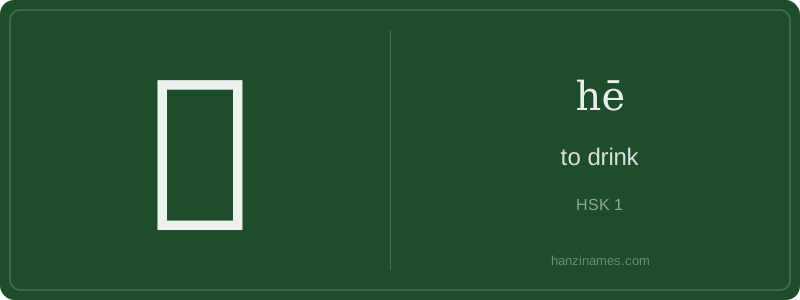
In everyday China, 喝 appears constantly—in teahouses where elders say '来,喝杯茶!' (Come, have a cup of tea!), in hospitals where nurses instruct patients to '多喝水' (drink more water), and in schools where teachers remind students to '喝水休息一下' (drink water and take a break). It’s essential in health campaigns, food safety notices, and even traffic warnings ('严禁酒后驾车' — strictly no driving after drinking alcohol). The phrase 喝西北风 (hē xīběi fēng, 'to drink northwestern wind') is a well-documented idiom meaning 'to go hungry'—attested in Qing-era literature and still used colloquially today.
The character’s form is not pictographic but phono-semantic: 口 clearly indicates oral action, while 葛 (gě) serves as a phonetic loan. Historical inscriptions from the Warring States period (475–221 BCE) show early forms with 口 + 葛-like components, confirming its ancient phonetic function—not a depiction of drinking, but a standardized sign for the verb based on sound association.
The character 喝 (hē) is one of the most frequently used verbs in daily Chinese, especially in social and domestic contexts. It appears early in language learning because drinking—tea, water, soup, or beverages—is central to Chinese routines. Its radical 口 (mouth) signals a mouth-related action, reinforcing its core meaning: ingestion of liquids. As an HSK Level 1 character, learners encounter it in basic sentences like 'I drink tea' or 'Please drink some water,' making it foundational for functional communication.
While hē is the dominant pronunciation meaning 'to drink,' the alternate reading hè appears in literary or expressive contexts—such as shouting orders ('hè cǎi' — cheering at a performance) or commanding attention. This dual pronunciation reflects Classical Chinese’s morphological economy: one written form serving distinct semantic domains via tone and context. Learners must master both pronunciations to understand idioms, opera chants, and even modern slogans.
Visually, 喝 is composed of the mouth radical 口 on the left and 葛 (a phonetic component historically suggesting sound) on the right. Though 葛 originally meant 'kudzu vine,' its role here is purely phonetic—guiding pronunciation toward hē/hè. The 12-stroke structure is balanced and legible, making it ideal for handwriting practice. Its simplicity belies cultural weight: in China, offering tea (喝茶) is a ritual of respect; refusing a drink can signal distance, while sharing one builds trust.
Example Sentences
Common Compounds
Similar Characters — Don't Mix These Up
Your First Step into Chinese Culture: Get a Chinese Name
Every journey into Chinese begins with a name. Use our free Chinese name generator to create a meaningful, personalized Chinese name that fits you perfectly.
Get My Chinese Name →