吗
Character Story & Explanation
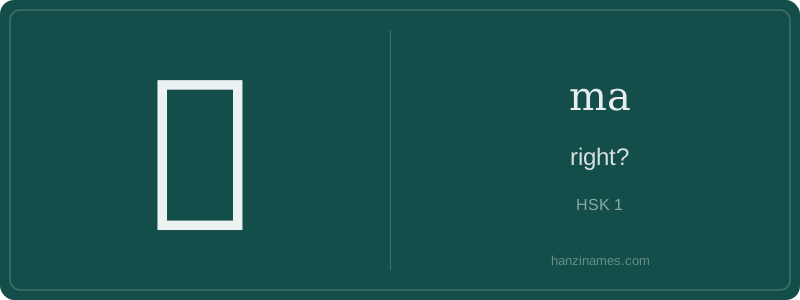
吗 is ubiquitous in spoken and written Mandarin today: appended to any statement to form a yes-no question—e.g., 你吃饭了 (nǐ chīfàn le, 'You ate') → 你吃饭了吗? (nǐ chīfàn le ma?, 'Did you eat?'). It appears in all major textbooks, official HSK exams, and digital communication. Historically, its earliest attested use is in Ming dynasty vernacular novels like Water Margin, where it replaces classical particles in dialogue to reflect actual speech patterns.
The character has no pictographic origin—it’s a phono-semantic compound created during the late imperial period. The left 口 (kǒu, 'mouth') indicates speech-related function; the right 马 (mǎ) provides approximate pronunciation. No oracle bone or bronze script forms exist. Instead, picture this: a Beijing student texts a friend, '今天去图书馆吗?'—instant, natural, unambiguous questioning—no rising tone needed on screen.
As a linguistic detective, I trace 吗 not through ancient inscriptions—since it’s a late-comer to writing—but through its grammatical fingerprints in Tang and Song dynasty vernacular texts. Unlike pictographic characters carved in oracle bone, 吗 emerged as a phonetic loan: the character 口 (mouth) was combined with 马 (mǎ, 'horse') purely for sound, not meaning. Its six strokes encode function, not form: the mouth radical signals speech, while the right component hints at pronunciation—evolving from Middle Chinese /ma/ to modern ma.
This particle doesn’t stand alone—it’s a grammatical chameleon, appended only to declarative sentences to flip them into yes-no questions. Crucially, it carries zero lexical weight: no dictionary defines 吗 as 'question'—it’s pure syntax. Its simplicity belies deep design: by adding just one stroke-final dot (the sixth stroke), Mandarin transforms statement into inquiry—no intonation shift required in writing, unlike English’s inverted word order.
Historically, 吗 stabilized during the Ming-Qing transition, replacing earlier particles like 未 (wèi) and 乎 (hū) in colloquial registers. Its HSK Level 1 status reflects pedagogical pragmatism: it’s the first question marker learners encounter because it’s high-frequency, orthographically simple, and structurally indispensable. Yet its power lies in absence—it adds no semantic content, only pragmatic force—making it a masterclass in how Chinese uses minimal written marks to encode maximal conversational intent.
Example Sentences
Common Compounds
Similar Characters — Don't Mix These Up
Your First Step into Chinese Culture: Get a Chinese Name
Every journey into Chinese begins with a name. Use our free Chinese name generator to create a meaningful, personalized Chinese name that fits you perfectly.
Get My Chinese Name →