回
Character Story & Explanation
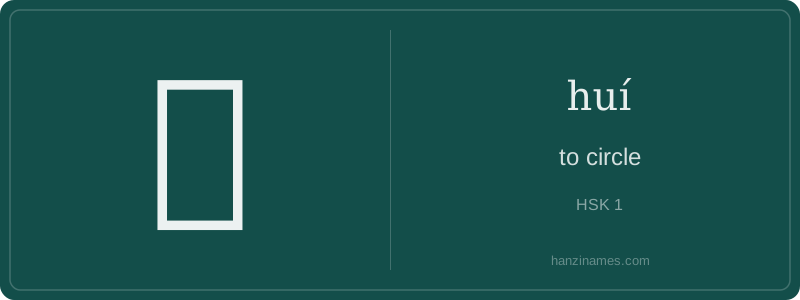
回 is ubiquitous in modern Mandarin: it appears in daily verbs like 回家 (huí jiā, 'go home'), 回答 (huí dá, 'to answer'), and 回来 (huí lái, 'to come back'). It’s central to the idiom 一去不复回 (yī qù bù fù huí, 'gone forever, never to return'), famously used in ancient poetry like Cao Cao’s *Short Song Style*. As a measure word (e.g., 三回 sān huí = 'three times'), it quantifies occurrences more naturally than English ‘times’.
Archaeologically, 回 first appeared in seal script (c. 3rd century BCE) as a symmetrical square-within-square—clearly pictographic of an enclosed path or circular route. Unlike disputed oracle-bone forms, this structure is consistently documented in bronze inscriptions and early dictionaries like the *Shuōwén Jiězì* (121 CE), which defines it as 'to turn back, to revolve' (轉也). No mythic origin is recorded—its form directly mirrors its meaning.
The Chinese character 回 (huí) is a foundational HSK Level 1 character with just six strokes and the enclosure radical 囗 (wéi), meaning 'enclosure' or 'boundary'. Its core semantic idea is 'to circle'—not merely physical rotation, but returning to a starting point, completing a loop, or reversing direction. This concept underpins its most common uses: 'to return', 'to go back', 'to reply', and 'to repeat'. Unlike English verbs that distinguish sharply between motion (go back) and communication (reply), 回 unifies them through the shared logic of cyclical movement—information circles back as a response, a person circles back home, time circles back in repetition.
Western equivalents like 'return', 'loop', or 'cycle' carry similar geometric or temporal connotations—but lack 回’s grammatical versatility. In English, 'return' is primarily a verb; 'loop' is often technical (programming, audio); 'cycle' implies duration and recurrence. 回, by contrast, functions seamlessly as verb, noun, and measure word (e.g., 一回 yī huí = 'one time'). This functional fluidity reflects classical Chinese’s preference for context-driven, multi-role characters over rigid parts of speech—a feature absent in Indo-European grammar.
Culturally, 回 evokes harmony through closure: returning home embodies filial piety; replying to a message fulfills social reciprocity; repeating a phrase signals attentiveness or learning. In contrast, Western individualism sometimes valorizes forward motion over return—think 'progress', 'innovation', 'break from tradition'. Yet modern Western concepts like 'feedback loops' or 'circular economy' increasingly mirror 回’s holistic, regenerative logic—suggesting converging intuitions about sustainability, dialogue, and balance across cultures.
Example Sentences
Common Compounds
Similar Characters — Don't Mix These Up
Your First Step into Chinese Culture: Get a Chinese Name
Every journey into Chinese begins with a name. Use our free Chinese name generator to create a meaningful, personalized Chinese name that fits you perfectly.
Get My Chinese Name →