坐
Character Story & Explanation
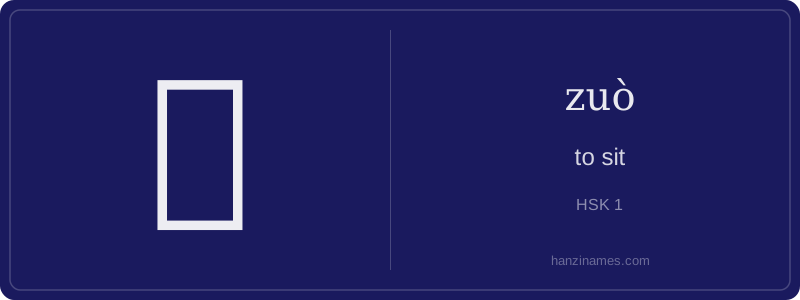
坐 is ubiquitous in modern Mandarin: used in transportation announcements (‘请坐好’ — ‘Please sit properly’), classroom instructions, and polite invitations (‘请坐’ — ‘Please have a seat’). It appears in idioms like 坐井观天 (zuò jǐng guān tiān, ‘sit in a well and observe the sky’), a metaphor for narrow-mindedness documented since the Warring States period in the *Zhuangzi*. The character also features in historical legal terms like 坐罪 (zuò zuì, ‘to be convicted by association’), reflecting its role in classical jurisprudence.
Archaeologically, the earliest secure form of 坐 appears in late Western Zhou bronze inscriptions (~9th c. BCE) as two facing 人 above a horizontal line—later standardized as 土. While not a direct pictograph of a person on a stool, it’s widely accepted as an ideographic representation of two people sitting opposite each other on the ground, emphasizing shared space and ritual seating.
As a linguistic detective, I begin with the oracle bone and bronze inscriptions—yet here, no clear pictographic ancestor of 坐 survives in early forms. Unlike characters such as 日 (sun) or 木 (tree), 坐 lacks unambiguous archaeological pictorial roots. Scholars note that its earliest attested forms (late Shang to Western Zhou) already resemble the modern structure: two 'people' (人) flanking a 'base' (土), suggesting seated posture on the ground—a conceptual rather than literal depiction.
The radical 土 (earth/soil) is not merely decorative—it anchors the meaning physically: sitting requires contact with the ground or a surface. The two 人 radicals, stacked symmetrically, represent human figures facing inward, knees bent, settled downward. This is not a photo-realistic image but a semantic diagram: presence + posture + support. Over centuries, calligraphic simplification smoothed the curves, but the structural logic remained intact.
Crucially, 坐 never evolved into a phonetic-semantic compound like many later characters; it’s a self-contained ideograph. Its stability across 3,000 years—retaining both form and core meaning—speaks to how fundamental ‘sitting’ is in Chinese ritual, governance, and daily life. From ancient court audiences to modern subway etiquette, 坐 encodes stillness, respect, and social positioning—not just posture, but presence grounded in place.
Example Sentences
Common Compounds
Similar Characters — Don't Mix These Up
Your First Step into Chinese Culture: Get a Chinese Name
Every journey into Chinese begins with a name. Use our free Chinese name generator to create a meaningful, personalized Chinese name that fits you perfectly.
Get My Chinese Name →