块
Character Story & Explanation
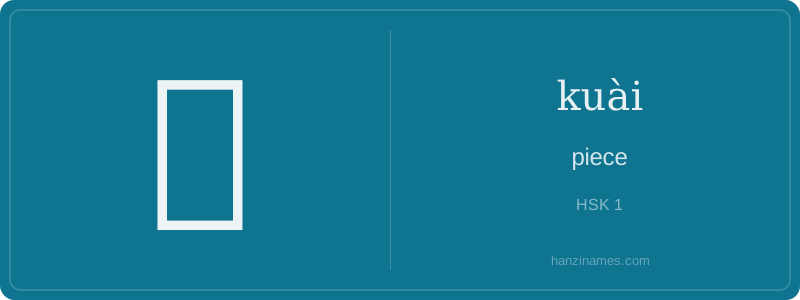
块 is ubiquitous in modern Mandarin: it's the standard classifier for currency (yuan), baked goods, candy, soap, tofu, and electronic devices (e.g., 一块手机). It appears in common phrases like 一块儿 (yī kuài r, 'together') and idioms such as 一块石头落了地 (yī kuài shí tou luò le dì, 'a stone falls to the ground' — meaning 'a great relief'). Historically, it appears in Tang dynasty texts referring to earth clods and later evolved into a general mass classifier during the Ming–Qing periods.
The character’s form combines 土 (radical, 'earth') with 夂 (zhǐ, an archaic component suggesting movement or completion) and 一 (horizontal stroke). While not a pictograph, its structure reflects its earliest documented use: describing lumps of soil or clay—verified in excavated Song-era tax records listing land measured in 'blocks' (块) of cultivated earth.
The Chinese character 块 (kuài) is a foundational HSK Level 1 word meaning 'piece', 'lump', or 'chunk'—but its most essential function is as a measure word (classifier) for discrete, solid, often irregularly shaped objects:一块蛋糕 (a piece of cake), 一块石头 (a stone), or 一块手表 (a watch). Unlike English, which uses generic 'a' or 'an', Mandarin requires specific classifiers, and 块 fills this role for many countable nouns with mass or compact form.
Western learners often struggle with classifiers, but 块 is among the most intuitive because it mirrors tangible, physical units—like 'a slab of cheese' or 'a hunk of bread' in English. It evokes tactile, grounded imagery: something you can hold, break, or place on a plate. This contrasts with abstract classifiers like 个 (gè), making 块 especially helpful for beginners visualizing concrete nouns.
Culturally, 块 carries subtle economic and colloquial weight: money is counted in 块 (e.g., 五块 = five yuan), reinforcing its association with tangible value—akin to 'buck' in American slang ('twenty bucks'). Its radical 土 (tǔ, 'earth/soil') hints at its original sense: clods of earth or soil lumps. Though now generalized, this earthy origin grounds the character in agrarian history—where measuring land or clay by 'lumps' was practical and widespread.
Example Sentences
Common Compounds
Similar Characters — Don't Mix These Up
Your First Step into Chinese Culture: Get a Chinese Name
Every journey into Chinese begins with a name. Use our free Chinese name generator to create a meaningful, personalized Chinese name that fits you perfectly.
Get My Chinese Name →