太
Character Story & Explanation
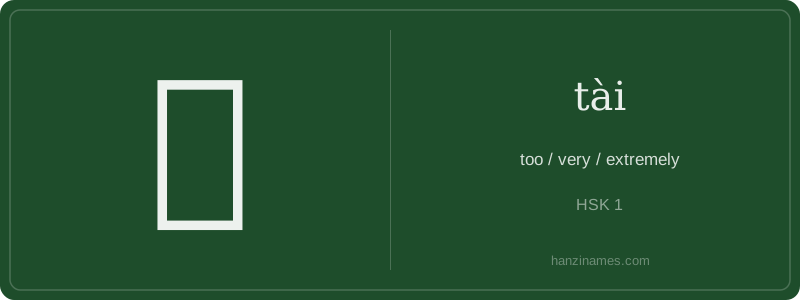
太 is ubiquitous in modern Mandarin: it appears in greetings (太棒了! 'Amazing!'), complaints (太贵了! 'Too expensive!'), and idioms like 太平盛世 (tàipíng shèngshì, 'era of great peace and prosperity'), a phrase dating back to Han Dynasty texts describing ideal governance. It’s also central in Daoist cosmology (e.g., 太极 tài jí, 'Supreme Ultimate'), reflecting its ancient philosophical weight. As a standalone word, it’s rarely used in formal writing but dominates spoken discourse for immediacy and emotional color.
The character evolved from oracle bone script forms resembling a person with exaggerated limbs — a stylized variant of 大 (dà, 'big') — emphasizing 'excessively big'. By the Warring States period, it had standardized into its current form, retaining the 大 radical and adding a dot (丶) to distinguish it phonetically and semantically from 大. No pictographic sun/moon association applies here — that belongs to characters like 日 or 月.
The Chinese character 太 (tài) is a foundational HSK Level 1 word expressing intensity or excess — meaning 'too', 'very', or 'extremely'. Unlike English adverbs like 'very' that modify adjectives directly ('very good'), 太 functions as an intensifier before adjectives or verbs in predicate position, always requiring a following adjective and often implying a subjective, emotionally charged judgment. Its brevity (just four strokes) belies its high frequency and pragmatic weight in daily speech.
Western equivalents vary by context: 'too' maps to English’s negative excess ('too loud'), while 'very' aligns with neutral emphasis ('very kind'). Yet 太 carries subtle evaluative nuance — it often implies the speaker’s personal reaction or mild surprise, similar to French 'trop' or Japanese 'sugoku', but with stronger potential for criticism or admiration depending on tone and context. It rarely stands alone and almost never modifies nouns directly.
In cultural usage, 太 reflects Confucian-influenced linguistic restraint: using 太 signals heightened feeling, so overuse can sound dramatic or unrefined. Compare this to English, where 'so' or 'really' are more casually deployed. In Mandarin, saying 太好了 (tài hǎo le, 'Too good!') conveys warm enthusiasm, whereas 'too good' in English may ironically imply suspicion — highlighting how the same lexical item can carry divergent pragmatic baggage across cultures.
Example Sentences
Common Compounds
Similar Characters — Don't Mix These Up
Your First Step into Chinese Culture: Get a Chinese Name
Every journey into Chinese begins with a name. Use our free Chinese name generator to create a meaningful, personalized Chinese name that fits you perfectly.
Get My Chinese Name →