女
Character Story & Explanation
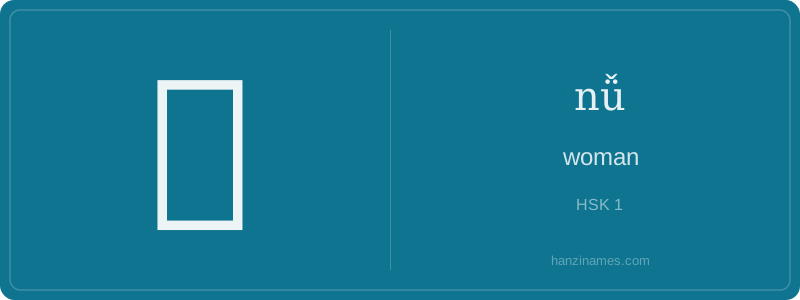
女 is ubiquitous in daily Chinese life: on ID cards (性别 xìngbié, 'sex/gender'), school forms, hospital records, and public signage (e.g., 女厕所 'women’s restroom'). It appears in foundational idioms like 男尊女卑 (nán zūn nǚ bēi, 'men superior, women inferior')—a historically documented Confucian hierarchy—and its modern counterpoint, 男女平等 (nán nǚ píngděng, 'gender equality'), enshrined in China’s 1954 Constitution. The character also features in official terminology like 女职工 (nǚ zhígōng, 'female employee'), reflecting decades of labor policy discourse.
Archaeologically verified oracle bone script shows 女 as a stylized kneeling woman with bent arms—a clear pictograph dating to c. 1250 BCE. Unlike later mythologized 'stories', this form is confirmed by Shang dynasty inscriptions and matches contemporary reconstructions of ritual posture, emphasizing humility and receptivity in early ritual contexts.
The character 女 (nǚ) is one of the oldest and most stable in Chinese writing—appearing identically in oracle bone inscriptions over 3,200 years old. Its enduring form reflects how deeply gender roles were codified early in Chinese civilization: not as abstract concepts, but as foundational social categories embedded in language itself. Unlike English, where 'woman' and 'female' occupy distinct grammatical spaces, 女 functions fluidly—as a noun, adjective, and radical—revealing a worldview where identity, kinship, and social function are linguistically inseparable.
Historically, 女 carried layered connotations: respect (as in 母亲 'mother'), relationality (as in 女儿 'daughter'), and even moral expectation (e.g., traditional virtues like 温柔 'gentleness'). Yet modern usage increasingly foregrounds agency—seen in terms like 女权 (nǚquán, 'women’s rights') and 女博士 (nǚ bóshì, 'female doctor')—signaling a cultural recalibration where the character no longer prescribes but affirms diverse female identities.
As a radical, 女 appears in over 200 characters—including 妈 (mā, 'mom'), 姐 (jiě, 'older sister'), and 婚 (hūn, 'marriage')—making it a semantic anchor for kinship, emotion, and social institutions. This pervasive presence underscores a core Confucian insight: society begins not with the individual or state, but with the family—and within the family, the feminine principle is structurally central, not peripheral. To learn 女 is to enter a grammar of relationship.
Example Sentences
Common Compounds
Similar Characters — Don't Mix These Up
Your First Step into Chinese Culture: Get a Chinese Name
Every journey into Chinese begins with a name. Use our free Chinese name generator to create a meaningful, personalized Chinese name that fits you perfectly.
Get My Chinese Name →