她
Character Story & Explanation
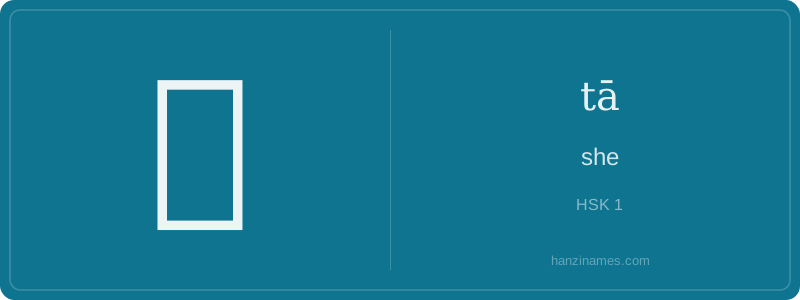
她 entered standard written Chinese in the 1920s during the New Culture Movement, championed by writers like Liu Bannong to modernize the language and reflect gender distinctions seen in European languages. Before this, 他 served for all genders. Today, 她 appears in over 95% of contemporary Chinese texts when referring to women or girls — from school textbooks to WeChat messages. You’ll find it in common phrases like '她是老师' (She is a teacher) and official documents requiring gender specificity.
The character is a semantic-phonetic compound: 女 (female) conveys meaning, and 也 historically contributed to pronunciation. While 也 itself evolved from an ancient pictograph meaning 'also', its role here is primarily phonetic. No oracle-bone or bronze script form of 她 exists — it’s a modern coinage, first documented in print around 1917–1920.
Hi students! Today we’re learning 她 (tā), meaning 'she' — the third-person singular feminine pronoun in Chinese. Unlike English, Chinese didn’t originally distinguish gender in third-person pronouns; 她 was created in the early 20th century to match Western grammatical expectations and promote clarity in writing. It’s pronounced with a flat, high tone — like singing a steady note — and is one of the first characters you’ll use when describing people.
This character belongs to HSK Level 1, so it’s essential and appears everywhere: textbooks, signs, subtitles, and daily conversation. Even though spoken Mandarin uses just tā for 'he', 'she', and 'it', written Chinese relies on three distinct characters: 他 (he), 她 (she), and 它 (it). That makes 她 crucial for reading comprehension — you’ll see it constantly in stories, news, and social media.
Notice its radical 女 (nǚ) — 'woman' — placed on the left side. This tells us immediately that the character relates to females. The right side, 也 (yě), is a phonetic component hinting at pronunciation (though not perfectly — it’s more about historical sound evolution). With only six strokes, 她 is simple to write, but mastering its stroke order builds confidence for more complex characters later.
Example Sentences
Common Compounds
Similar Characters — Don't Mix These Up
Your First Step into Chinese Culture: Get a Chinese Name
Every journey into Chinese begins with a name. Use our free Chinese name generator to create a meaningful, personalized Chinese name that fits you perfectly.
Get My Chinese Name →