姐
Character Story & Explanation
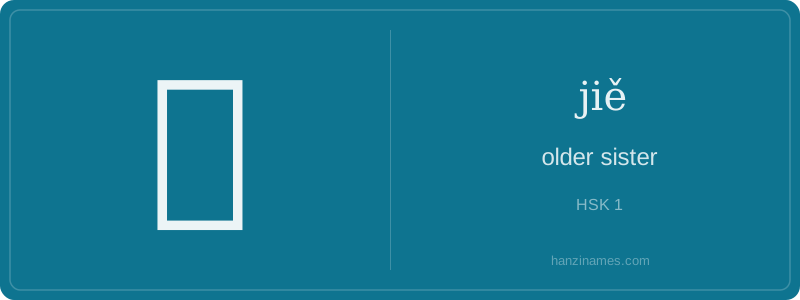
姐 is widely used in daily life: children address their elder sisters directly as 姐 or 姐姐 (jiějie), and adults often use 姐姐 as a polite, friendly term for slightly older women—even strangers—in service settings (e.g., calling a female shop clerk 'Jiějie'). Historically, it appears in texts like the Tang dynasty *Yongle Dadian* and Qing-era vernacular novels, consistently denoting senior female siblings. It's also embedded in idioms like 姐弟情深 (jiědì qíngshēn, 'deep bond between older sister and younger brother').
The character is not a pictograph but a phono-semantic compound: the radical 女 (nǚ, 'woman') indicates meaning category, while the phonetic component 帝 (dì, 'emperor')—now simplified visually—originally suggested pronunciation. Though 帝 no longer sounds like jiě, this structure reflects standard character formation from the Shuōwén Jiězì (c. 100 CE), confirming its long-established semantic logic.
The Chinese character 姐 (jiě) means 'older sister' and is among the first family-related terms learners encounter in HSK Level 1. Unlike English, which uses a single word 'sister' regardless of age order, Mandarin distinguishes siblings by relative seniority—making 姐 essential for accurate kinship expression. It reflects Confucian-influenced values emphasizing hierarchy and respect within the family, where birth order carries social and linguistic weight.
Grammatically, 姐 functions as a noun but also appears in honorific or affectionate contexts beyond blood relations—for example, calling a young female colleague or friend 'Jiě' signals warmth and respectful familiarity. This usage mirrors Japanese 'onee-san' or Korean 'noona', yet differs from Western norms where 'sister' isn’t repurposed socially without biological ties.
In contrast to English’s gender-neutral 'sibling' or context-dependent 'big sister', 姐 is strictly feminine and age-specific. There’s no neutral or diminutive form built into the character itself—it relies on modifiers (e.g., 大姐 'eldest sister') or tone/context for nuance. This precision highlights how Chinese kinship terms encode relational data linguistically, unlike English’s more flexible, role-optional naming.
Example Sentences
Common Compounds
Similar Characters — Don't Mix These Up
Your First Step into Chinese Culture: Get a Chinese Name
Every journey into Chinese begins with a name. Use our free Chinese name generator to create a meaningful, personalized Chinese name that fits you perfectly.
Get My Chinese Name →