妈
Character Story & Explanation
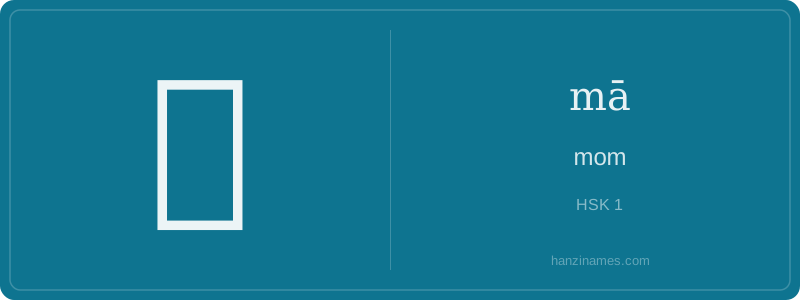
In modern Mandarin, 妈 is the default, warm, informal term for 'mother'—used by children, adults, and even in media (e.g., CCTV’s 'Mom, I’m Home!' TV dramas). It appears in fixed phrases like 妈妈的味道 (māma de wèidào, 'the taste of mom'), symbolizing comfort food and nostalgia. Historically, it first appeared in vernacular literature during the Song dynasty (960–1279), notably in storytelling scripts and Yuan zaju plays, marking a shift from classical 母 (mǔ) to spoken forms.
The character is a phono-semantic compound: 女 (nǚ, 'female') as semantic radical, and 马 (mǎ, 'horse') as phonetic component. Though 马 is pronounced mǎ, historical sound shifts—including loss of the entering tone and vowel raising—led to mā. No pictographic origin exists; it’s purely a later orthographic innovation for a common spoken word.
As an archaeologist sifting through layers of linguistic sediment, I uncover 妈 not in oracle-bone inscriptions—where it does not appear—but in the rich strata of early Chinese lexicography. The earliest attested form appears in the Shuōwén Jiězì (c. 100 CE), where Xu Shen classifies it as a phono-semantic compound: the radical 女 (nǚ, 'woman') signals semantic domain, while 马 (mǎ, 'horse') provides phonetic approximation—though tone and vowel have shifted from mǎ to mā. This reflects how spoken language evolves faster than script.
This character is a quiet revolution in writing: unlike ancient kinship terms tied to ritual hierarchy (e.g., 母 for 'mother' in bronze inscriptions), 妈 emerged later as a colloquial, affectionate form—first documented in Song dynasty vernacular texts and Ming dynasty drama scripts. Its rise mirrors the growing literary space for domestic speech, where mothers speak and are spoken to—not just invoked in ancestral rites. It’s a fossilized whisper of everyday love.
The six-stroke simplicity belies its cultural weight: each stroke excavates a layer of social change. The three-dot ‘female’ radical anchors it in gendered roles; the right-side 马, though now silent in meaning, once echoed the sound children might babble—mā being one of the earliest cross-linguistically universal caregiver syllables. Like finding a child’s clay impression beside a royal seal, 妈 reveals how intimacy reshaped writing—not through power, but through repetition, tenderness, and daily use.
Example Sentences
Common Compounds
Similar Characters — Don't Mix These Up
Your First Step into Chinese Culture: Get a Chinese Name
Every journey into Chinese begins with a name. Use our free Chinese name generator to create a meaningful, personalized Chinese name that fits you perfectly.
Get My Chinese Name →