细
Character Story & Explanation
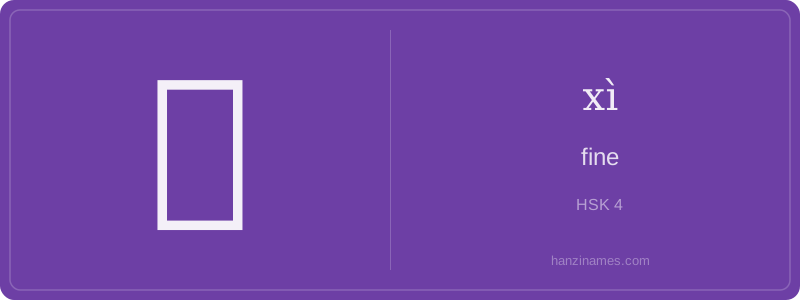
In modern Mandarin, 细 is ubiquitous in compound words and idioms reflecting precision and subtlety. It appears in HSK-4 vocabulary like 细心 (xìxīn, 'attentive'), 细节 (xìjié, 'detail'), and the idiom 明察秋毫 (míngchá qiūháo)—literally 'to perceive the down of an autumn ox', meaning 'to notice the finest details'. Historically, 细 was used in Tang dynasty poetry to describe delicate brushwork and Song dynasty texts to denote fine-grained soil or thread counts in imperial silk standards.
The character’s form derives from the silk radical 纟 plus 田 (tián, 'field')—but not as agriculture. In seal script, the right side evolved from 絀 (a variant meaning 'to draw tight'), emphasizing tension and narrowness. Today, Chinese learners practice its stroke order (dot, then three linked strokes for 纟, followed by four for the right component) while chefs, artisans, and teachers all use 细 to praise or demand exacting care.
Imagine walking through Beijing’s Panjiayuan Antique Market on a crisp autumn morning. A master calligrapher sits cross-legged, his inkstone polished smooth, brush poised above rice paper. He dips the tip into jet-black ink—so fine it seems to hold its breath—and draws 细: eight precise strokes flowing like silk threads. Each movement is deliberate, controlled; the character doesn’t just mean 'thin'—it embodies refinement, attention, and quiet strength. In Chinese aesthetics, thinness isn’t weakness—it’s elegance in restraint.
The radical 纟 (sī), meaning 'silk', anchors 细 in textile culture—a legacy of China’s ancient sericulture. Historically, the finest silk threads were prized for their fineness (xì), symbolizing skill, patience, and value. Even today, when a Shaoxing chef slices century eggs into translucent ribbons or a Suzhou embroiderer uses a single strand of silk—split from one filament into sixteen—people murmur, 'Zhè hěn xì!' ('This is very fine!'). It’s a word that carries tactile memory.
But 细 also extends beyond physical thinness. In daily speech, it describes meticulousness—like checking train schedules 'xì xīn' (carefully) before a family trip to Xi’an—or subtle emotional nuance, as when a grandmother says, 'Nǐ xì kàn, tā yǎnshén lǐ yǒu bù ān' ('Look closely—there’s unease in his eyes'). Its power lies in bridging the sensory and the perceptual: what you see, feel, measure—and what you intuit.
Example Sentences
Common Compounds
Similar Characters — Don't Mix These Up
Your First Step into Chinese Culture: Get a Chinese Name
Every journey into Chinese begins with a name. Use our free Chinese name generator to create a meaningful, personalized Chinese name that fits you perfectly.
Get My Chinese Name →