绝
Character Story & Explanation
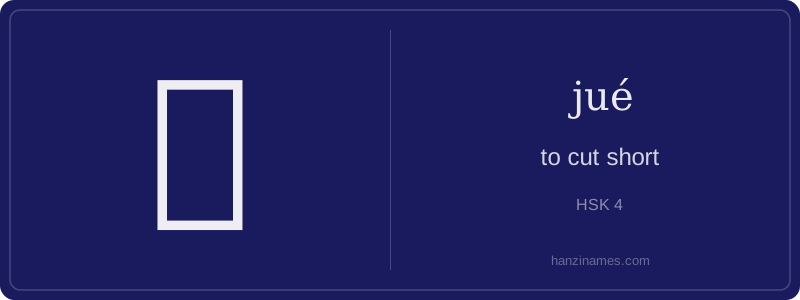
In daily use, 绝 most commonly appears in high-frequency compounds: 绝对 (juéduì, ‘absolute/definitely’) is ubiquitous in spoken Mandarin—e.g., ‘我绝对不去’ (‘I absolutely won’t go’); 绝望 (juéwàng, ‘despair’) reflects its classical sense of ‘cut off from hope.’ Historically, it appears in Tang dynasty poetry (e.g., Li Bai’s ‘蜀道之难,难于上青天’—where ‘绝’ in ‘绝壁’ means ‘sheer, unclimbable cliff’) and legal texts meaning ‘to terminate lineage’ (绝嗣).
The character’s form has no verified oracle bone origin, but its small seal script (c. 200 BCE) clearly combines 糸 (thread) + 从 (phonetic, later simplified). Today, Chinese people use it instinctively in emphatic negation: ‘绝了!’ (jué le!) — an internet slang exclamation meaning ‘That’s unreal!’ or ‘Mind-blowing!’, repurposing ‘cut-off’ as ‘beyond normal categories.’
As a linguistic detective, I begin at the scene: the modern character 绝 (jué), nine strokes, radical 纟 (silk/thread). Its left side—糹—signals connection to textiles or binding; historically, cutting thread was a visceral metaphor for severing continuity. The right side, 从 (cóng) in ancient forms, evolved into +色—now stylized as and 色—but originally conveyed 'following' then shifted phonetically. This isn’t arbitrary: early seal script (c. 3rd c. BCE) shows a hand holding scissors near silk—literally ‘cutting the thread.’
The semantic core is rupture: not just physical severance, but termination of possibility—hence ‘absolute,’ ‘unique,’ ‘desperate.’ In classical texts like the *Zuo Zhuan*, 绝 appears in phrases like ‘绝其后’ (cut off their rear), describing military strategy. Over centuries, the ‘cutting’ sense abstracted: if you cut all paths, only one remains—thus ‘peerless’ (绝技) or ‘utterly’ (绝不可能). This semantic expansion is logical, not mystical.
Crucially, 绝 never meant ‘excellent’ as a standalone value judgment—it’s always relational: something is ‘absolute’ *because* alternatives are severed; ‘unique’ *because* comparison is cut off. Even its HSK 4 status reflects this duality: learners must grasp both concrete cessation (断绝) and abstract extremity (绝对). Confusing it with 好 (good) or 优 (superior) misses its structural logic: it’s about boundaries, not quality. That’s why idioms like 万念俱绝 (‘all thoughts utterly cut off’) retain the original force—emotional finality, not positivity.
Example Sentences
Common Compounds
Similar Characters — Don't Mix These Up
Your First Step into Chinese Culture: Get a Chinese Name
Every journey into Chinese begins with a name. Use our free Chinese name generator to create a meaningful, personalized Chinese name that fits you perfectly.
Get My Chinese Name →