脱
Character Story & Explanation
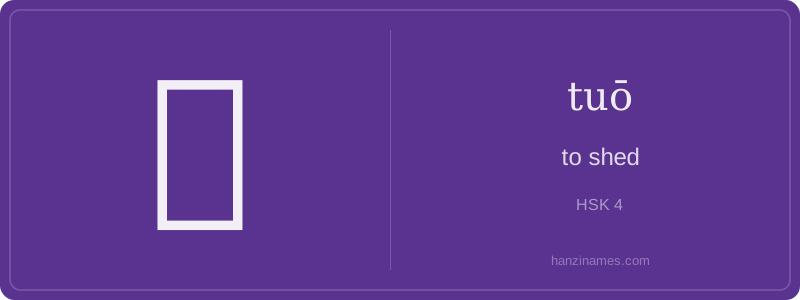
Historically documented in the Shuōwén Jiězì (121 CE), 脱 was defined as ‘to remove, to take off’, with its modern meaning ‘to shed’ solidified by Tang–Song medical and literary texts. Common compounds include 脱衣 (tuō yī, ‘to undress’) and 脱贫 (tuō pín, ‘to escape poverty’—a key national policy term since 2013). The idiom 脱颖而出 (tuō yǐng ér chū, ‘to rise above the crowd’) originates from the Warring States period, referencing a sword emerging from its scabbard.
The character’s form has no oracle-bone precursor; it first appears in seal script during the Qin dynasty. Its left side ⺼ clearly denotes the body, while 兑 evolved from a pictograph of a person opening mouth (later stylized). In daily life, Chinese people use 脱 constantly—from weather apps warning of ‘脱水’ (tuō shuǐ, dehydration) to headlines declaring ‘成功脱贫’ (‘successfully escaped poverty’).
As an archaeologist brushing dust from a Han dynasty bamboo slip, I find 脱 etched not as a static glyph but as a kinetic verb—its left radical ⺼ (flesh/meat) anchoring it in the body’s material reality, while the right component 兑 (duì) originally signified ‘to exchange’ or ‘to open’, later evolving phonetically. This duality reveals ancient Chinese perception: shedding isn’t passive loss but an intentional, almost transactional release—of skin, garments, or constraints.
Excavations at Mawangdui revealed medical texts using 脱 to describe pathological ‘sloughing’ of tissue—a clinical precision centuries ahead of its time. The character appears alongside diagnostic terms like 脱证 (tuō zhèng, 'deficiency syndrome'), reflecting a sophisticated somatic theory where bodily integrity depended on retaining vital substances like qi and blood. Here, 脱 is not metaphor—it’s forensic.
Unlike Western binaries of ‘loss vs. gain’, 脱 embodies dynamic equilibrium: to shed a fevered sweat (脱汗) is therapeutic; to shed authority (脱身) is strategic retreat. Its eleven strokes map a ritual arc—from attachment (left flesh radical) to release (right phonetic), mirroring Daoist wu-wei: effortless action through timely letting go. Even today, calligraphers pause before the final dot stroke—echoing the ancient breath held mid-shedding.
Example Sentences
Common Compounds
Similar Characters — Don't Mix These Up
Your First Step into Chinese Culture: Get a Chinese Name
Every journey into Chinese begins with a name. Use our free Chinese name generator to create a meaningful, personalized Chinese name that fits you perfectly.
Get My Chinese Name →