袜
Character Story & Explanation
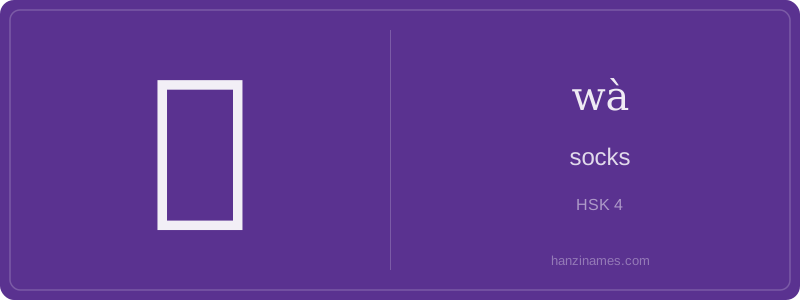
袜 is widely used in modern Chinese daily life—from shopping ('买三双袜子' mǎi sān shuāng wàzi, 'buy three pairs of socks') to laundry ('洗袜子' xǐ wàzi, 'wash socks') and health contexts ('防臭袜' fáng chòu wà, 'anti-odor socks'). It appears in standardized HSK 4 vocabulary lists and product labeling across e-commerce platforms like Taobao and JD.com. No major idioms center on 袜, but it frequently occurs in compound terms related to textile quality and function.
The character evolved from the older form 襪 (wà), with the modern simplified version 袜 first officially adopted in the 1956 Chinese Character Simplification Scheme. Its left side 衤 is a variant of 衣 (yī, 'clothing'), confirming its lexical category; the right side 末 (mò, 'end, tip') serves phonetically—though pronunciation shifted over time. This is a documented case of phonosemantic compounding, not pictographic origin.
The Chinese character 袜 (wà) means 'socks'—a common garment covering the foot and lower leg. Unlike English, which uses a single uncountable noun ('socks'), Chinese treats 袜 as a countable noun that typically appears in pairs (e.g., 一双袜子 yī shuāng wàzi), reflecting its functional duality. Its radical 衤 (the 'clothing' radical) clearly signals its semantic category, anchoring it among other apparel-related characters like 衬 (chèn, 'shirt') and 裤 (kù, 'pants').
Western sock culture emphasizes fashion, branding, and seasonal variation—think argyle patterns or athletic compression socks—whereas traditional Chinese usage prioritized warmth, modesty, and practicality. Historically, silk and cotton socks were status markers; today, mass-produced synthetic socks dominate daily wear, yet the cultural weight remains: removing shoes indoors (and thus exposing socks) is still socially sensitive in many Chinese households.
In cross-cultural communication, misusing 袜 can cause subtle confusion: for example, saying 我买袜 (wǒ mǎi wà) without measure words sounds incomplete to native speakers, unlike English 'I bought socks.' Also, while Western idioms rarely feature socks (beyond 'pull up your socks'), Chinese expressions like 袜子破了 (wàzi pò le, 'socks are torn') colloquially signal minor but telling failures—echoing how small details reflect larger carelessness.
Example Sentences
Common Compounds
Similar Characters — Don't Mix These Up
Your First Step into Chinese Culture: Get a Chinese Name
Every journey into Chinese begins with a name. Use our free Chinese name generator to create a meaningful, personalized Chinese name that fits you perfectly.
Get My Chinese Name →