规
Character Story & Explanation
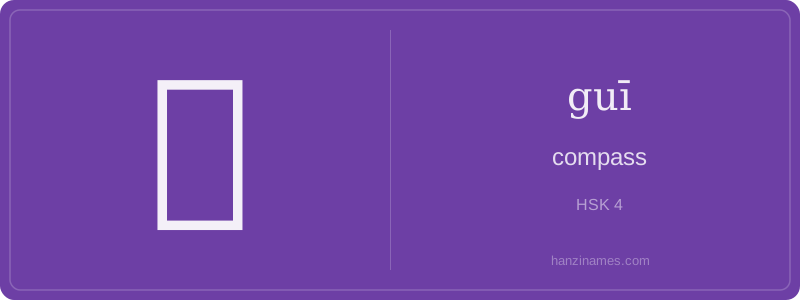
Historically, 规 referred to the ancient Chinese compass — one of the 'Four Great Inventions' precursors — used in architecture, astronomy, and ritual geometry. It appears in classical texts like the Mencius (3rd c. BCE) in the phrase '不以规矩,不能成方圆' ('Without compass and square, one cannot make circles or squares'), emphasizing standards for moral and practical order. Today, it’s ubiquitous in modern terms like '规则' (guīzé, 'rule') and '规范' (guīfàn, 'standard/specification'). Government documents, school handbooks, and tech manuals all rely on this character.
The character evolved from seal script, where the left side resembled '夫' (a man with arms outstretched, suggesting measurement), and the right side '见' (to see) reinforced the idea of visualizing standards. No oracle bone form survives, but bronze inscriptions from the Warring States period show early versions clearly tied to surveying tools.
Hi students! Let’s learn 规 (guī), an HSK Level 4 character with 8 strokes and the ‘see’ radical (见). Though its basic meaning is 'compass' — the drawing tool used to make perfect circles — it’s rarely used alone today. Instead, it appears in compound words related to rules, standards, and regulation. Think of it like the 'circle' symbolizing fairness, precision, and boundaries — just as a compass draws consistent, repeatable curves.
This character carries deep cultural weight: in ancient China, 'guī' and 'ju' (矩, carpenter’s square) together represented moral standards — 'guī ju' meant proper conduct. So while 规 literally draws circles, it metaphorically draws lines for acceptable behavior. Don’t confuse it with characters that mean 'law' (法) or 'order' (序); 规 emphasizes *measurable, standardized* norms — like school rules or technical specifications.
Writing it correctly matters! Start with the left-side '夫' component (not '天'), then finish with '见'. Remember: the top stroke of '夫' is flat, not slanted — a common mistake. Since it shares the 'see' radical, link it to the idea of 'seeing clearly what is standard' — like checking alignment with a compass. Practice slowly, stroke by stroke, and say 'guī' aloud each time to reinforce pronunciation and meaning.
Example Sentences
Common Compounds
Similar Characters — Don't Mix These Up
Your First Step into Chinese Culture: Get a Chinese Name
Every journey into Chinese begins with a name. Use our free Chinese name generator to create a meaningful, personalized Chinese name that fits you perfectly.
Get My Chinese Name →