亲
Character Story & Explanation
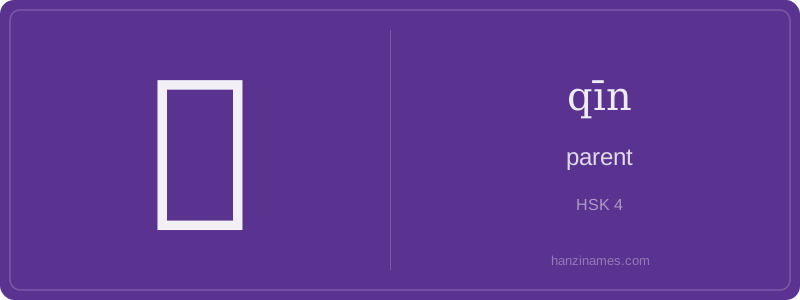
Historically, 亲 appears frequently in classical texts like the Analects and the Book of Rites, always denoting blood ties or morally sanctioned closeness. In imperial examinations, candidates cited ‘亲亲而仁民’ (love kin first, then extend benevolence to people) as foundational ethics. Today, it’s ubiquitous in formal and digital contexts: government notices use 亲民政策 (people-friendly policies); Taobao sellers greet buyers as ‘亲’; and the phrase 亲上加亲 (qīn shàng jiā qīn, ‘kinship upon kinship’) describes marriages between cousins—still socially accepted in some regions.
The character evolved from seal script, where 立 (standing upright) forms the top radical, and 木 (tree) + 见 (to see) were later simplified to 亲’s bottom component. Though its oracle-bone origin is lost, the modern form—9 strokes, with 立 on top—visually conveys ‘standing close’: stability and proximity fused in one ideograph.
The character 亲 (qīn) opens a window into the Confucian heart of Chinese relational ethics—where kinship is not merely biological but a moral foundation for society. Its core meaning 'parent' extends outward to encompass all close, intimate bonds: spouse, child, sibling, and even trusted friends. This reflects the classical ideal of 'filial piety as the root of virtue' (孝为德之本), where reverence for parents cultivates integrity in public life.
Unlike Western individualism, Chinese worldview sees identity as woven through relational roles—and 亲 anchors that web. The character appears in governance terms like 亲民 (qīn mín, 'to love and serve the people'), echoing Mencius’ belief that rulers must treat subjects as family. Thus, 亲 carries ethical weight: intimacy implies responsibility, not just affection.
This relational depth explains why 亲 thrives in modern digital culture—e.g., netizens address each other as 亲 (‘dear customer’ or ‘fellow netizen’) to simulate warmth and trust. Even in e-commerce, sellers write ‘亲,您好!’—a linguistic gesture that bridges commercial exchange with familial care. Here, ancient virtue becomes a pragmatic social lubricant, revealing how China’s moral grammar endures in everyday speech.
Example Sentences
Common Compounds
Similar Characters — Don't Mix These Up
Your First Step into Chinese Culture: Get a Chinese Name
Every journey into Chinese begins with a name. Use our free Chinese name generator to create a meaningful, personalized Chinese name that fits you perfectly.
Get My Chinese Name →