谅
Character Story & Explanation
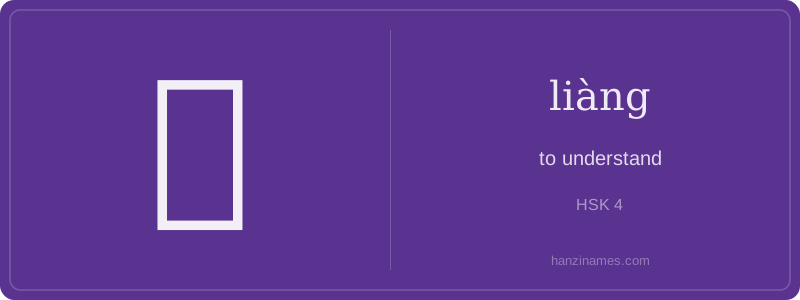
In modern Chinese, 谅 appears most frequently in formal or literary contexts: apology acceptance (‘请谅’ on official letters), classical allusions (e.g., ‘体谅’ in workplace empathy training), and fixed phrases like ‘不谅’ (‘unforgiving’) in legal or historical dramas. It’s rare in casual speech—native speakers prefer 对不起 or 原谅—but essential in written civility and HSK 4+ reading comprehension.
The character’s form derives from the phono-semantic compound structure documented in the Shuōwén Jiězì (121 CE): 讠 (speech) + 凉 (liáng, phonetic and semantic echo of ‘calming emotion’). No pictographic origin exists—it was invented as a linguistic tool for Confucian ethical discourse, reflecting the Han dynasty’s systematic codification of moral vocabulary.
Our detective begins at the crime scene: the character 谅, written with the speech radical 讠 and the phonetic component 凉 (liáng, 'cool'). This is a classic xíngshēng (phono-semantic) compound—no ancient oracle bone mystery here, but a deliberate Han dynasty-era construction. The radical signals its domain: language, communication, and interpersonal judgment. Its phonetic element hints at pronunciation while subtly reinforcing meaning—'cooling' emotional heat to make room for understanding.
Zooming in on the strokes: ten precise movements, beginning with the dot-and-hook of 讠, then the balanced left-right structure of 凉 without water (冫). Note how the right side drops the ice radical 冫 in favor of 凉’s simplified form—standardized in the 1956 script reform. This isn’t evolution by accident; it’s bureaucratic refinement for literacy, preserving semantic intent while streamlining writing.
Crucially, 谅 has never meant passive forgiveness—it’s active moral reasoning. Classical texts like the Analects use it for empathetic judgment ('understanding others’ limits'), not absolution. Even today, saying ‘我谅你’ carries quiet weight: 'I choose to understand your position,' not 'I excuse your mistake.' It implies discernment—hence its HSK 4 placement: learners must grasp nuance, not just vocabulary.
Example Sentences
Common Compounds
Similar Characters — Don't Mix These Up
Your First Step into Chinese Culture: Get a Chinese Name
Every journey into Chinese begins with a name. Use our free Chinese name generator to create a meaningful, personalized Chinese name that fits you perfectly.
Get My Chinese Name →