象
Character Story & Explanation
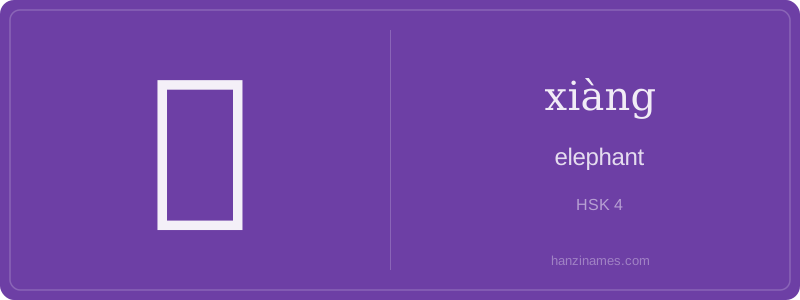
象 appears frequently in modern Chinese across contexts: as a zoological term (e.g., in wildlife documentaries or zoo signage), in idioms like ‘盲人摸象’ (‘blind men touching an elephant’ — illustrating partial understanding), and in formal terms like ‘现象’ (phenomenon) and ‘象征’ (symbol). Historically, elephants once roamed central China during the Shang and Zhou dynasties, evidenced by oracle bone inscriptions and bronze vessel motifs — making 象 one of the earliest recorded animal characters.
The character’s earliest form (in oracle bone script) was a clear pictograph: a stylized elephant with trunk, tusks, and legs. Archaeologists have confirmed this through inscriptions on turtle shells and bones dating to ~1200 BCE — no speculation needed! Its evolution from pictograph to today’s standardized form reflects consistent visual logic across 3,000 years.
Hi there! Let’s learn 象 (xiàng), a Level 4 HSK character meaning 'elephant'. Though it looks complex with 11 strokes, it’s built logically: the top part (⺈ + 丷) resembles an elephant’s trunk and ears, while the bottom 豕 (shǐ) is the ‘pig’ radical — historically used for large mammals in ancient Chinese script. Don’t worry about memorizing every stroke yet; focus on recognizing its shape and sound.
This character is more than just an animal name — it’s deeply symbolic. In Chinese culture, elephants represent wisdom, strength, and good fortune (think of the idiom ‘太平有象’ — peace and prosperity). You’ll also meet 象 in abstract uses like ‘image’, ‘appearance’, or ‘symbol’ — yes, the same character means both ‘elephant’ and ‘phenomenon’! That’s because early writing linked concrete animals to visible forms.
As a beginner, start by practicing the stroke order slowly: top-left to bottom-right, following the standard rules (horizontal before vertical, left before right). Write it 5 times while saying ‘xiàng’ aloud. Notice how the two dots (丶) at the top echo elephant eyes — a tiny visual clue! Once you’re comfortable, explore compound words like ‘现象’ (phenomenon) and ‘象征’ (symbol) — they’ll appear often in news, textbooks, and daily conversation.
Example Sentences
Common Compounds
Similar Characters — Don't Mix These Up
Your First Step into Chinese Culture: Get a Chinese Name
Every journey into Chinese begins with a name. Use our free Chinese name generator to create a meaningful, personalized Chinese name that fits you perfectly.
Get My Chinese Name →