负
Character Story & Explanation
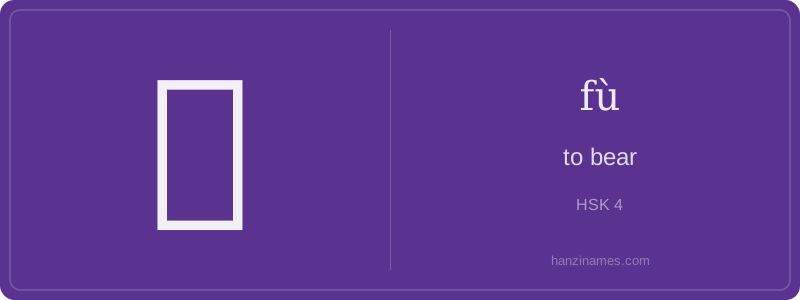
Historically, 负 appears in excavated Qin legal bamboo slips (c. 221 BCE) meaning 'to owe (money)' or 'to be liable', confirming its early fiscal sense. In modern usage, it’s central to HSK-4 vocabulary: common in compounds like 负责 (fùzé, 'to be responsible') and 负担 (fùdān, 'burden'). The idiom 不负众望 (bù fù zhòngwàng, 'to live up to public expectations') is widely used in news and speeches, reflecting its enduring moral weight.
The character’s structure is not pictographic but phono-semantic: 贝 (bèi) is the semantic component (indicating value/debt), while 付 (fù, now simplified to +一) served as the phonetic cue in ancient forms. No oracle bone inscriptions of 负 survive; its earliest attested form is in Warring States bronze inscriptions, showing clear association with accounting and obligation.
As an archaeologist brushing dust from a Han dynasty bamboo slip, I find 负 etched not as a burden—but as a ledger entry. Its radical 贝 (bèi), meaning 'cowrie shell', reveals its origin in ancient Chinese commerce: cowries were currency, and 负 originally denoted carrying debt or financial obligation. The top component—⺈ (a variant of 刂, the knife radical) combined with 一—evolved into today’s simplified form, but early seal script shows a person bent under weight, arms gripping a sack of shells.
This character’s semantic gravity deepened during the Warring States period, when legal texts used 负 to assign accountability—'to bear responsibility for a crime' or 'to shoulder military duty'. Unlike passive verbs, 负 implies conscious assumption: not merely 'carrying', but *accepting* weight—moral, fiscal, or existential. Its six strokes encode millennia of bureaucratic precision: every line reflects administrative necessity, not poetic metaphor.
By the Tang dynasty, poets like Du Fu wielded 负 with ethical resonance—'bearing shame for the fallen empire' or 'bearing loyalty despite exile'. Even today, the character resists casual use: it appears in formal registers—legal documents, academic titles, and solemn vows—not in slang or greetings. To write 负 is to invoke consequence. Its minimal stroke count (6) belies maximal semantic density: a linguistic artifact where economics, law, and ethics converge in one compact glyph.
Example Sentences
Common Compounds
Similar Characters — Don't Mix These Up
Your First Step into Chinese Culture: Get a Chinese Name
Every journey into Chinese begins with a name. Use our free Chinese name generator to create a meaningful, personalized Chinese name that fits you perfectly.
Get My Chinese Name →