货
Character Story & Explanation
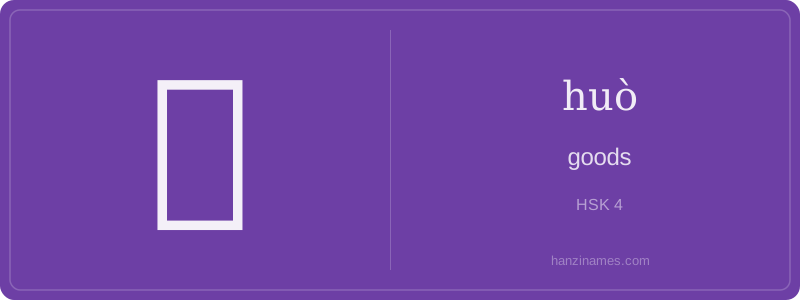
In daily life, 货 is ubiquitous in China’s retail and logistics ecosystems: delivery riders scan QR codes labeled ‘货已发出’ (huò yǐ fāchū, 'goods dispatched'), supermarket shelves display ‘进口货’ (jìn kǒu huò, 'imported goods'), and WeChat Pay receipts list ‘商品货款’ (shāngpǐn huò kuǎn, 'merchandise payment'). A well-documented idiom is ‘货真价实’ (huò zhēn jià shí), meaning 'genuine goods at fair price' — used since the Ming Dynasty in merchant guild regulations and still cited in State Administration for Market Regulation consumer advisories.
The character’s form combines 贝 (radical, historically representing shell money) with 化 (huà, 'to change/transform') — not as a pictograph but as a phono-semantic compound (sound hint: huà → huò). While its oracle-bone origins are lost, bronze inscriptions from the Warring States period (475–221 BCE) already use 货 to denote taxable commodities, confirming its early association with state-regulated trade.
The character 货 (huò) embodies the tangible essence of commerce in Chinese society — from bustling Shanghai wholesale markets to rural Yunnan village co-ops. Its radical 贝 (bèi), meaning 'shell', reflects ancient China’s use of cowrie shells as currency, anchoring the concept of 'goods' in material value and exchange. This historical layer remains vivid: when a Taobao seller labels an item ‘现货’ (xiàn huò, 'in-stock goods'), they’re invoking millennia-old trade logic — goods as transferable, quantifiable assets.
Modern usage extends beyond physical items: ‘水货’ (shuǐ huò, 'gray-market goods') reveals how 货 adapts to digital-era ethics, while ‘干货’ (gān huò, literally 'dried goods') metaphorically means 'substance-packed, practical knowledge' — a favorite term among educators and tech bloggers. This semantic elasticity shows how 货 bridges concrete commerce and abstract value, making it indispensable in both market reports and online learning forums.
At HSK Level 4, 货 signals a learner’s entry into socio-economic fluency. It appears in key phrases like ‘货运’ (huò yùn, freight transport) and ‘货款’ (huò kuǎn, payment for goods), essential for business Chinese. Unlike generic terms like 物 (wù, 'thing'), 货 implies intentionality — goods meant for trade, not just objects. Mastering it unlocks authentic participation in conversations about supply chains, e-commerce logistics, or even debates on counterfeit products — all deeply rooted in China’s evolving commercial identity.
Example Sentences
Common Compounds
Similar Characters — Don't Mix These Up
Your First Step into Chinese Culture: Get a Chinese Name
Every journey into Chinese begins with a name. Use our free Chinese name generator to create a meaningful, personalized Chinese name that fits you perfectly.
Get My Chinese Name →