迷
Character Story & Explanation
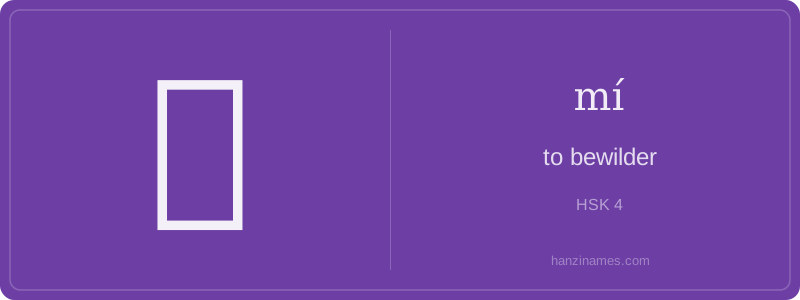
迷 is widely used in modern Chinese for both literal and figurative 'loss': 迷路 (mí lù, 'to get lost') is one of the most common phrases taught early — appearing in travel guides, subway announcements, and safety brochures across China. It also appears in idioms like 恋恋不舍 (liàn liàn bù shě), where 迷 is not present, but related words like 迷恋 (mí liàn, 'to be infatuated') are frequent in literature and media. Historically, 迷 appears in Tang dynasty poetry describing spiritual confusion or Daoist meditation states — and today, it's central in terms like 网迷 (wǎng mí, 'internet addict'), reflecting contemporary social concerns.
The character’s form combines 米 (mǐ, 'rice') above and 辶 ('walking') below — not a pictograph, but a phono-semantic compound: 米 suggests pronunciation (ancient sound similarity), while 辶 signals motion-related meaning. No oracle-bone form survives; the earliest attested use is in bronze inscriptions from the Warring States period, meaning 'to lose one’s way'.
Hi students! The character 迷 (mí) means 'to bewilder' or 'to be confused' — like when you’re lost in a maze or can’t understand a difficult idea. It’s an action verb, often used reflexively (e.g., 迷路 — 'to get lost') or to describe strong emotional or intellectual attraction (e.g., 迷上音乐 — 'to become obsessed with music'). Its pronunciation mí is a high-level, level-one tone — steady and clear, like a firm but gentle note on a piano.
This character belongs to HSK Level 4, so it appears frequently in intermediate textbooks and real-life conversations — especially when talking about confusion, fascination, or direction. You’ll see it in travel contexts ('getting lost'), learning situations ('confused by grammar'), and even pop culture ('a fan of K-pop'). Mastering 迷 helps you express not just physical disorientation, but also the delightful kind — like being captivated by art or ideas.
Remember: 迷 always implies *movement* toward confusion or fascination — which makes sense because its radical 辶 (chuò) is the 'walking' or 'moving' radical! That little 'walk' at the bottom reminds us that bewilderment isn’t static — it’s something you *enter into*, step by step. So when you write it, think of walking into fog — slowly, carefully, and with awareness.
Example Sentences
Common Compounds
Similar Characters — Don't Mix These Up
Your First Step into Chinese Culture: Get a Chinese Name
Every journey into Chinese begins with a name. Use our free Chinese name generator to create a meaningful, personalized Chinese name that fits you perfectly.
Get My Chinese Name →