速
Character Story & Explanation
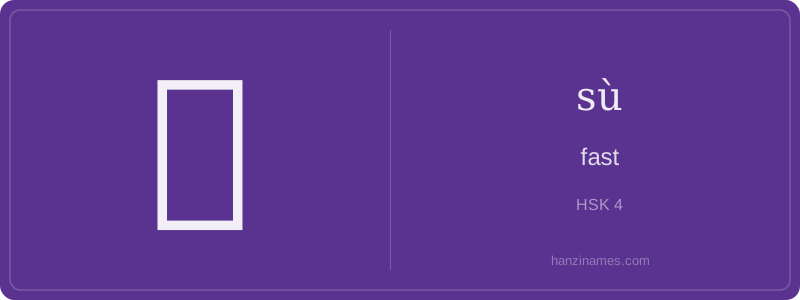
In daily life, 速 is ubiquitous in signage, tech interfaces, and official communications — especially in time-sensitive contexts. It appears in standardized phrases like ‘请速办理’ (qǐng sù bàn lǐ, ‘Please process promptly’), a common directive in government service windows and bank queues. The idiom ‘速战速决’ (sù zhàn sù jué, ‘swift battle, swift victory’) is widely used in business and media to advocate decisive action. Historically, 速 appears over 120 times in the *Analects* and *Mencius*, often cautioning against hasty judgment — showing its longstanding semantic duality: efficiency versus recklessness.
The character’s form is well-documented: it’s a phono-semantic compound. The 辶 radical (‘walking’) signals motion-related meaning, while 束 (shù) serves as the phonetic component — a usage confirmed by bronze inscriptions from the Warring States period. No oracle-bone form survives, but seal script variants (c. 3rd c. BCE) already show the familiar structure: movement + sound.
Imagine rushing through Beijing’s bustling Xidan subway station at 8 a.m. — commuters flood the platforms, eyes locked on their phones, bags swinging, footsteps echoing. A digital sign flashes: ‘列车速到’ (lièchē sù dào) — ‘Train arriving shortly’. Here, 速 isn’t abstract; it’s the pulse of urban efficiency, the quiet urgency in every timed escalator, every express delivery bike weaving through traffic. This character carries the weight of China’s accelerated modernity — where speed is measured not just in kilometers per hour, but in app notifications, same-day logistics, and real-time payments.
Etymologically, 速 belongs to the 辶 (chuò) radical — the ‘walking’ or ‘movement’ component — paired with 束 (shù), which originally meant ‘to bind tightly’ and later contributed phonetically. In ancient texts like the *Zuo Zhuan*, 速 appears in phrases like ‘速祸’ (sù huò, ‘to hasten disaster’), revealing its early moral nuance: speed wasn’t always virtuous. The character thus embodies a cultural tension — between progress and prudence, urgency and consequence.
Today, 速 thrives in compound words that define contemporary life: 高速 (gāosù, ‘high-speed’) anchors China’s 40,000-km高铁 network; 速食 (sùshí, ‘instant food’) reflects evolving eating habits; and 速率 (sùlǜ, ‘rate/speed’) underpins everything from 5G latency metrics to AI training benchmarks. It’s a lexical engine — compact, directional, and indispensable in a society where time is both currency and constraint.
Example Sentences
Common Compounds
Similar Characters — Don't Mix These Up
Your First Step into Chinese Culture: Get a Chinese Name
Every journey into Chinese begins with a name. Use our free Chinese name generator to create a meaningful, personalized Chinese name that fits you perfectly.
Get My Chinese Name →