连
Character Story & Explanation
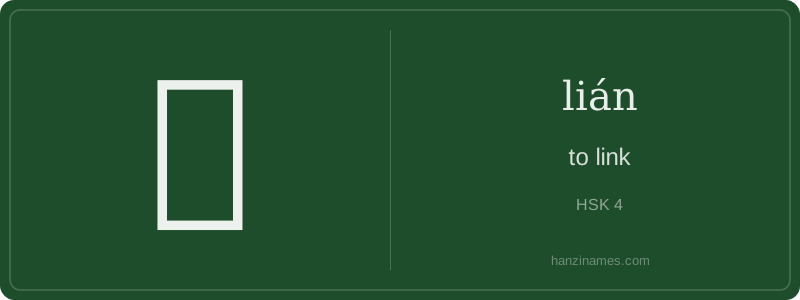
连 is ubiquitous in modern Chinese: it appears in compound verbs like 连接 (liánjiē, 'to connect'), bureaucratic terms like 连带责任 (liándài zérèn, 'joint liability'), and idioms such as 连绵不断 (liánmián bùduàn, 'uninterrupted, like continuous rain'). Historically, it appears in pre-Qin texts like the *Zuo Zhuan*, describing political alliances ('linked states'). In the 20th century, it entered revolutionary vocabulary: 连队 (liànduì, 'platoon') reflects military organization built on hierarchical linkage.
The character evolved from seal script (c. 3rd c. BCE), where its left side was 車 (chē, 'cart'), symbolizing movement and transport, while 辶 (the 'walking' radical) emphasized motion-based connection. Though not a pictograph, this structure documents an ancient understanding: linking requires agency, direction, and continuity—not passive attachment, but active traversal between points.
The character 连 (lián) embodies the Chinese worldview of relationality—where nothing exists in isolation. Its radical 辶 (chuò), meaning 'to walk' or 'movement', combined with 车 (chē, 'cart/vehicle') as its phonetic component, suggests dynamic connection: things in motion linking together. This reflects Confucian and Daoist ideals—harmony arises not from static unity, but from continuous, purposeful interlinking of people, ideas, and systems.
In Chinese cosmology, connection is generative: heaven links to earth through qi; ruler connects to subjects through virtue; language binds thought to action. 连 thus carries ethical weight—it implies responsibility in linkage. To ‘link’ is never neutral; it demands intention, continuity, and mutual reinforcement—mirroring how rivers connect mountains to sea, or how generations bind past and future through ritual and memory.
This relational logic permeates daily life: networks (网络 wǎngluò), loyalty (连带责任 liándài zérèn), and even digital infrastructure (5G联网 wǔgē liánwǎng) all rely on 连’s underlying principle—that strength lies not in singularity, but in resilient, adaptive ties. Unlike Western individualism, the Chinese vision sees identity as co-constituted through such links, making 连 a quiet yet profound articulation of communal ontology.
Example Sentences
Common Compounds
Similar Characters — Don't Mix These Up
Your First Step into Chinese Culture: Get a Chinese Name
Every journey into Chinese begins with a name. Use our free Chinese name generator to create a meaningful, personalized Chinese name that fits you perfectly.
Get My Chinese Name →