邀
Character Story & Explanation
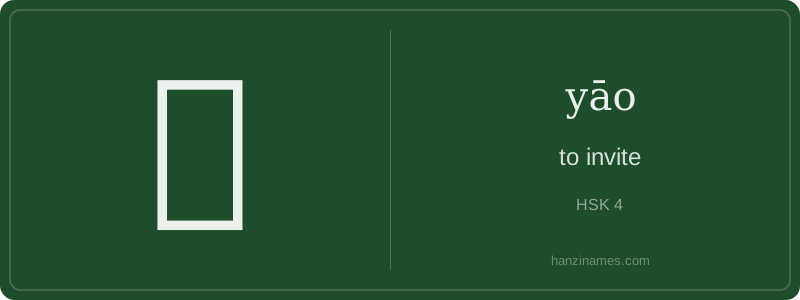
In modern China, 邀 appears ubiquitously in formal communication: university admission letters say ‘诚邀您参加’ (We sincerely invite you to attend), corporate WeChat announcements use ‘特邀嘉宾’ (specially invited guest), and government press releases begin with ‘国务院邀请中外记者’ (The State Council invites domestic and foreign journalists). The phrase 邀请函 (yāoqǐng hán, ‘invitation letter’) is a standardized document type regulated by administrative practice since the 1980s.
The character’s structure is not pictographic but phono-semantic: the left component 尧 (yáo) provides sound, while the right-running radical 辶 (‘walking’) conveys motion toward someone — consistent with its meaning. No oracle bone or bronze script form survives; it first appears reliably in Han dynasty clerical script inscriptions as a standard term for official summoning or ceremonial calling.
The character 邀 (yāo) captures the warmth and intentionality of human connection in Chinese culture — not just a casual 'ask,' but a deliberate, respectful act of extending welcome. Its radical 辶 (chuò), meaning 'to walk' or 'movement,' suggests active outreach: the inviter moves toward another, bridging space and relationship. This reflects Confucian values of reciprocity and face-conscious hospitality, where an invitation carries social weight and expectation.
Visually, 邀 combines 辶 with 尧 (yáo), a phonetic component historically associated with legendary sage-emperor Yao — subtly evoking virtue and legitimacy in the act of inviting. At HSK Level 4, learners encounter 邀 in formal and semi-formal contexts: event announcements, business emails, or academic collaborations. It rarely appears in slang or ultra-casual speech (where 叫 or 请 may dominate), signaling its register as polite and purposeful.
Unlike English ‘invite,’ which can be passive ('I was invited'), 邀 is almost always transitive and agentive — someone actively 邀请 (yāoqǐng) another. Its 16 strokes demand careful sequencing: the walking radical wraps last, reinforcing that the action culminates in movement toward the guest. Mastery signals not only linguistic competence but cultural fluency in navigating social rituals like banquets, weddings, or conference participation in China.
Example Sentences
Common Compounds
Similar Characters — Don't Mix These Up
Your First Step into Chinese Culture: Get a Chinese Name
Every journey into Chinese begins with a name. Use our free Chinese name generator to create a meaningful, personalized Chinese name that fits you perfectly.
Get My Chinese Name →