郊
Character Story & Explanation
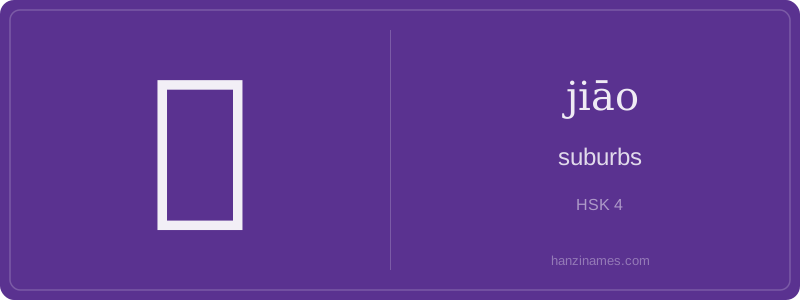
In daily usage, 郊 appears most frequently in compound words like 郊区 (jiāo qū, 'suburban district') and 郊游 (jiāo yóu, 'outing to the suburbs'), especially in urban contexts where commuting to satellite towns or green belts is common. Historically, it was central to state ritual: the *Book of Rites* and Han dynasty records document the emperor’s annual ‘suburban sacrifice’ (郊祀) south of Chang’an and later Beijing—a rite so vital it shaped imperial calendar and architecture for over two millennia.
The character’s form is well-documented: 郊 is a phono-semantic compound. The left component 交 (jiāo, 'to intersect') provides pronunciation and hints at 'meeting point'; the right radical 阝 (originally 阜, fù, 'mound' or 'hill') signifies terrain—literally 'the intersecting hill/mound area', i.e., land where city meets countryside. No oracle-bone form survives, but its seal-script appearance (c. 3rd c. BCE) already shows this structure.
The character 郊 (jiāo) embodies a quiet but profound spatial philosophy in traditional Chinese thought: the 'suburbs' are not merely outskirts, but a liminal, harmonious threshold between human settlement and untamed nature. Unlike Western binaries of 'urban vs. rural,' 郊 evokes ritualized proximity—where ancient emperors performed suburban sacrifices (郊祀, jiāo sì) to Heaven at the southern outskirts, affirming cosmic order through deliberate, bounded distance from the capital.
This zone was never marginal in meaning—it was sacred periphery. The *Rites of Zhou* designated specific suburban altars for seasonal rites, reinforcing that civilization’s legitimacy required regular communion with heaven and earth just beyond city walls. Thus, 郊 reflects a worldview where boundaries are relational, not exclusionary—culture extends outward in reverence, not conquest.
Even today, 郊 retains this layered resonance: modern Chinese may say ‘去郊区’ (go to the suburbs), yet the word still subtly carries echoes of spaciousness, transitional calm, and intentional retreat. It’s why weekend outings to Beijing’s Xiangshan or Hangzhou’s West Lake outskirts are often described with 郊游 (jiāo yóu)—not just ‘suburban trips,’ but culturally coded excursions into cultivated nature, echoing millennia-old rhythms of balance between human life and the wider landscape.
Example Sentences
Common Compounds
Similar Characters — Don't Mix These Up
Your First Step into Chinese Culture: Get a Chinese Name
Every journey into Chinese begins with a name. Use our free Chinese name generator to create a meaningful, personalized Chinese name that fits you perfectly.
Get My Chinese Name →