释
Character Story & Explanation
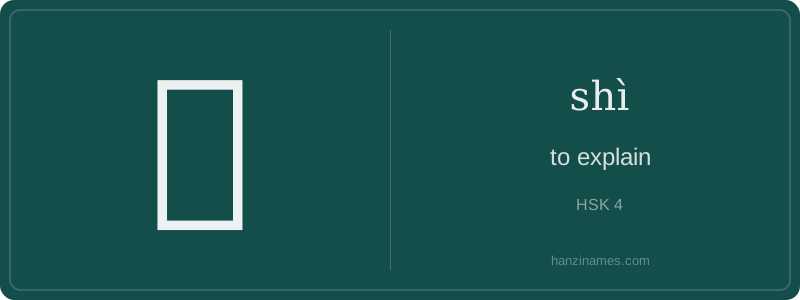
释 is ubiquitous in modern Chinese education, law, and media — especially in phrases like 解释 (jiěshì, 'to explain'), 批注释义 (pīzhù shìyì, 'annotated interpretation'), and 法律解释 (fǎlǜ shìyì, 'legal interpretation'). It appears in official documents from China’s Supreme People’s Court and is required vocabulary in HSK 4 exams. Historically, it was central to Han dynasty exegetical scholarship (e.g., the Mao Shi Zhuan commentary on the Book of Odes), where scholars used 释 to unpack archaic poetic language for imperial audiences.
The character’s form evolved from seal script: the left side 釆 (biàn) originally depicted 'distinguishing with discernment' (like a hand selecting grains), and the right side (a variant of 亦) served phonetic and semantic reinforcement. While not a pictograph, its structure signals 'careful differentiation → clarification'. Today, students learn it via stroke order drills, and professionals use it daily when drafting explanations in reports, teaching materials, or judicial opinions.
The Chinese character 释 (shì) fundamentally means 'to explain', 'to interpret', or 'to clarify' — an act of making something intelligible through reasoned articulation. Unlike English verbs like 'explain' that focus on the speaker’s action, 释 carries a subtle connotation of *unbinding* or *releasing meaning* — rooted in its historical use in classical texts to 'release' hidden significance from ancient words or doctrines. It appears frequently in academic, legal, and religious contexts, especially where authoritative interpretation is required.
In Western traditions, explanation often centers on logic, evidence, or pedagogy — think of Socratic dialogue or scientific exposition. By contrast, 释 embodies a more holistic, context-sensitive act: it implies responsibility toward textual fidelity and moral nuance, particularly in Confucian commentary or Buddhist sutra translation. A scholar who 释s a classic isn’t just defining terms — they’re mediating tradition, bridging eras, and honoring intent — closer to the role of a rabbinic midrashist or Islamic mufassir than a modern textbook author.
This distinction highlights how language encodes cultural epistemology: while English ‘explain’ prioritizes clarity and transfer of information, 释 emphasizes *legitimate derivation* — meaning must be drawn out with integrity, not imposed. That’s why 释 rarely stands alone in speech; it thrives in compounds like 注释 (zhùshì, annotation) or 解释 (jiěshì, explanation), where ‘release’ is paired with ‘unfolding’ or ‘noting’. Its semantic weight reflects East Asian intellectual values: humility before text, reverence for lineage, and explanation as ethical practice.
Example Sentences
Common Compounds
Similar Characters — Don't Mix These Up
Your First Step into Chinese Culture: Get a Chinese Name
Every journey into Chinese begins with a name. Use our free Chinese name generator to create a meaningful, personalized Chinese name that fits you perfectly.
Get My Chinese Name →