键
Character Story & Explanation
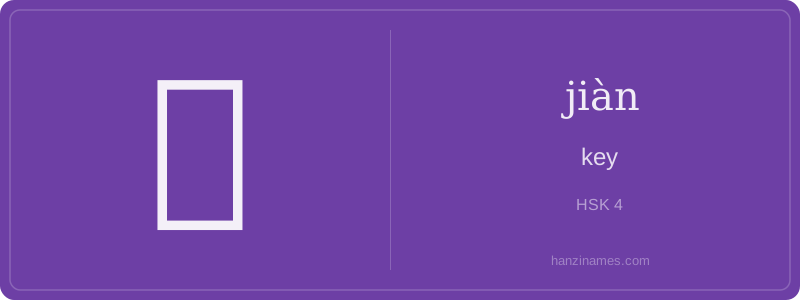
In contemporary Chinese, 键 is indispensable in digital life: people say ‘按回车键’ (àn huíchē jiàn, 'press the Enter key'), ‘功能键’ (gōngnéng jiàn, 'function key'), and ‘关键词’ (guānjiàn cí, 'keyword') — a term central to search engines and SEO since the early 2000s. It appears in official documents from China’s Ministry of Industry and IT regarding keyboard standards and accessibility guidelines. The term ‘关键’ (guānjiàn, 'crucial') — literally 'gate key' — has been used since at least the Ming Dynasty in military texts to denote decisive factors.
键 is a phono-semantic compound: 钅 (metal radical) signals material origin, while 建 (jiàn) provides pronunciation and conceptual weight ('to establish'). Its earliest attested form appears in Song-era printed dictionaries, not oracle bones — it’s a relatively late character, born from technological need rather than ancient ritual.
Hi students! Today we’re learning 键 (jiàn), meaning 'key' — like a keyboard key or a metaphorical 'key' to understanding something. It’s a Level 4 HSK character, so it’s common in intermediate textbooks and daily tech vocabulary. Notice its left-side radical 钅 (jīn zì páng), the 'metal' radical — this tells us 键 originally relates to metal objects, like physical keys or mechanical parts. That’s why it appears in words about hardware, computing, and even cryptography.
The right side 建 (jiàn) is a phonetic component — it gives the sound and also carries meaning: 'to build' or 'to establish'. So 键 subtly suggests something foundational — a 'key' that builds access or unlocks understanding. This dual role (sound + meaning hint) is typical of many Chinese characters, making them richer than simple symbols.
Don’t confuse 键 with other 'key'-related words like 钥 (yào, as in 钥匙 yàoshi — 'physical key'). 键 is almost always used in modern, abstract, or technical contexts: computer keys, keyword searches, or pivotal concepts. As you practice writing it (13 strokes!), remember the metal radical on the left — anchor your hand there first, then build the right side step by step!
Example Sentences
Common Compounds
Similar Characters — Don't Mix These Up
Your First Step into Chinese Culture: Get a Chinese Name
Every journey into Chinese begins with a name. Use our free Chinese name generator to create a meaningful, personalized Chinese name that fits you perfectly.
Get My Chinese Name →