际
Character Story & Explanation
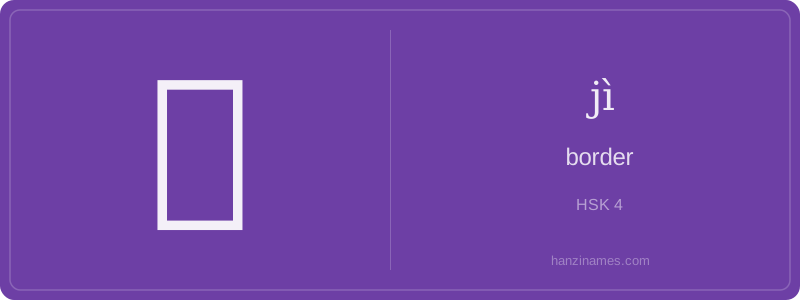
际 is widely used in modern Standard Chinese across formal and literary registers—especially in compound nouns denoting temporal, spatial, or relational boundaries. It appears in HSK 4+ vocabulary such as 国际 (guójì, 'international'), 世纪之交 (jìshù zhī jiāo, 'turn of the century'), and 人际 (rénjì, 'interpersonal'). The idiom 天涯海角 (tiānyá hǎijiǎo, 'ends of the earth') uses 角 (jiǎo) rather than 际, but 际 appears in its near-synonym 天际 (tiānjì, 'horizon'), a poetic term found in Tang dynasty poetry and modern weather reports alike.
The character 际 evolved from seal script, where it combined 阝 (a variant of 邑, 'city') with 册 (a pictograph of bamboo slips bound together). Scholars confirm its earliest attested use appears in Warring States bamboo texts (4th c. BCE) meaning 'boundary of a fiefdom'. Its structure reflects administrative precision—not natural geography—highlighting how early Chinese states conceptualized borders as documented, jurisdictional interfaces.
The Chinese character 际 (jì) fundamentally denotes a boundary or interface—where two entities meet or interact. Unlike the English word 'border', which often implies political division or physical separation, 际 emphasizes relational contact: the edge *between* things—time and space, people and society, reality and imagination. It carries a subtle philosophical weight in Chinese thought, echoing Daoist and Confucian ideas about transitional moments and liminal spaces where meaning is negotiated, not fixed.
Western equivalents like 'border', 'threshold', or 'brink' capture aspects of 际 but lack its inherent dynamism. A 'border' in Anglo-American contexts is frequently fortified and static; 际, by contrast, is permeable and process-oriented—it appears in phrases like 世纪之交 (jìshù zhī jiāo, 'turn of the century'), where it marks a fluid, culturally significant juncture rather than a line on a map. This reflects a broader Sino-cultural tendency to value harmony-in-transition over binary opposition.
In daily usage, 际 rarely stands alone—it thrives in compounds, lending nuance to abstract concepts. Its radical 阝 (right ear, representing 'city wall' or 'area') grounds it in spatiality, while the phonetic component 册 (cè, 'book/record') hints at documented, formalized boundaries—like treaties, eras, or social spheres. Thus, 际 subtly bridges geography, time, and human relationships, making it indispensable for expressing interconnectedness—a concept central to Chinese worldview but linguistically underrepresented in many Western languages.
Example Sentences
Common Compounds
Similar Characters — Don't Mix These Up
Your First Step into Chinese Culture: Get a Chinese Name
Every journey into Chinese begins with a name. Use our free Chinese name generator to create a meaningful, personalized Chinese name that fits you perfectly.
Get My Chinese Name →