随
Character Story & Explanation
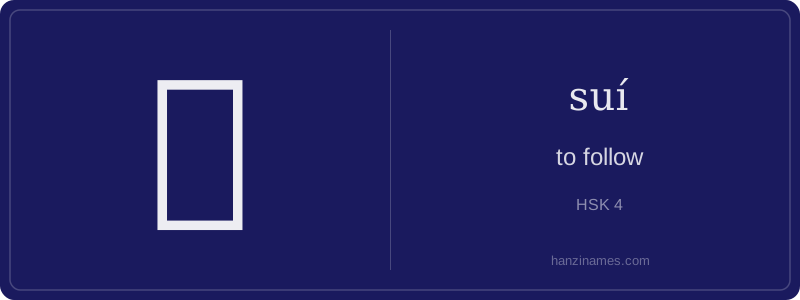
随 is deeply embedded in modern Mandarin usage — especially in polite, bureaucratic, and literary contexts. It appears in common phrases like 随时 (suíshí, 'at any time'), 随身 (suíshēn, 'on one’s person'), and the idiom 随遇而安 (suí yù ér ān, 'to be content wherever one finds oneself'), a Confucian-inspired ideal of adaptable calm. Historically, 随 was used in classical texts like the *Zuo Zhuan* to describe vassal states following a ruler’s lead — emphasizing loyalty through voluntary alignment.
The character’s form evolved from seal script: left side is 辶 (chuò, 'walk') + right side is 隋 (suí, originally a place name). The 阝 on the right is the 'city wall' or 'terrain' radical — not a hill — reflecting its origin as the name of the Sui Dynasty (581–618 CE), whose name itself came from the ancient state of Sui. So 随 literally carries historical weight: 'to follow [the Sui]'. Today, Chinese people use it daily — e.g., in WeChat messages saying 随时联系我 (suíshí liánxì wǒ, 'contact me anytime').
Hi students! Let’s learn 随 (suí), a Level 4 HSK character meaning 'to follow' — but not just physically. It often implies going along with something naturally, willingly, or without resistance: following instructions, adapting to circumstances, or accompanying someone. Its tone is neutral-to-positive — think of it as 'going with the flow' in a respectful, flexible way.
The character has 11 strokes and uses the right-side 'hill' radical 阝 (fù), which historically relates to terrain or location — hinting that ‘following’ often happens *in place* or *within context*, like following a path or a local custom. Don’t confuse it with verbs like 跟 (gēn) — 随 feels more formal and intentional, especially in written or polite speech.
Notice how 随 appears in many compound words about adaptation and compliance — from 随便 (suíbiàn, 'casually') to 随从 (suícóng, 'attendant'). That’s because its core idea isn’t blind obedience, but mindful alignment: following *appropriately*. Master this nuance, and you’ll understand subtle social cues in Chinese — like when someone says 随意 (suíyì), they’re inviting you to relax *within shared expectations*.
Example Sentences
Common Compounds
Similar Characters — Don't Mix These Up
Your First Step into Chinese Culture: Get a Chinese Name
Every journey into Chinese begins with a name. Use our free Chinese name generator to create a meaningful, personalized Chinese name that fits you perfectly.
Get My Chinese Name →