险
Character Story & Explanation
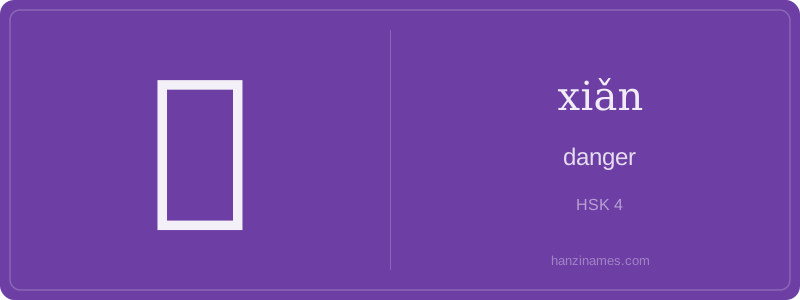
In modern Chinese, 险 appears ubiquitously in safety signage (危险! 'Danger!'), insurance documents (保险 'insurance'), and news headlines like '险遭车祸' ('nearly involved in a traffic accident'). It’s central to HSK 4 vocabulary and occurs in set phrases such as 化险为夷 ('turn danger into safety'), cited in Ming-dynasty military treatises and still taught in middle-school textbooks.
The character’s form derives from seal script: the left 阝 (fù, 'mound/hill' radical) is a stylized hill with ascending slope; the right part evolved from 檢 (jiǎn), originally meaning 'to examine closely'—reflecting the idea that danger requires vigilance. No oracle bone form exists; earliest attestation is on late Warring States bamboo manuscripts (c. 300 BCE), where it denotes treacherous terrain in geographic registers.
As an archaeologist brushing dust from a Warring States bamboo slip, I found 险 inscribed not as abstract peril—but as a cliffside path where chariots risked collapse. Its left side, 阝 (the 'hill' radical, originally 阜), anchors the character in topography: danger was first understood as physical terrain—steep slopes, unstable ground, narrow mountain passes that dictated military strategy and trade routes.
The right component, 检 (jiǎn) — simplified today but historically linked to 残 (cán, 'to injure') or 僉 (qiān, 'to gather') — evolved phonetically, yet its early forms suggest surveillance or caution. Oracle bone and bronze inscriptions don’t contain 险; it emerges fully in seal script (c. 3rd c. BCE), revealing how bureaucratic states began codifying risk—tax records noted 'dangerous roads', legal texts prescribed penalties for neglecting 'dangerous walls'.
This character’s nine-stroke form crystallized during the Qin standardization, when scribes needed precise, unambiguous glyphs for administrative clarity. The final dot stroke (丶) isn’t decorative—it’s a deliberate ‘warning mark’, echoing tally notches used in ancient granaries to flag compromised grain stores. Thus, 险 is less a philosophical concept than a logistical alert: danger as measurable, locatable, and preventable.
Example Sentences
Common Compounds
Similar Characters — Don't Mix These Up
Your First Step into Chinese Culture: Get a Chinese Name
Every journey into Chinese begins with a name. Use our free Chinese name generator to create a meaningful, personalized Chinese name that fits you perfectly.
Get My Chinese Name →