首
Character Story & Explanation
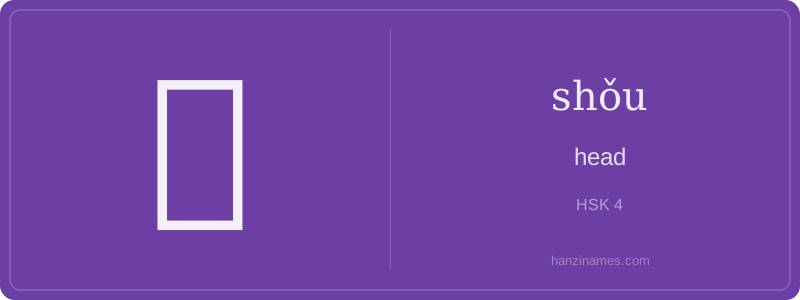
Historically, 首 appears in early bronze inscriptions (c. 11th–3rd century BCE) as a pictograph depicting a person’s head with emphasized eyes and hair — confirmed by archaeological evidence from Shang and Zhou dynasty ritual vessels. By the Han dynasty, it was already used in bureaucratic titles like 首辅 (shǒufǔ, 'Grand Secretary') and in military ranks. Today, it’s indispensable in formal speech: news reports say 首次 (shǒucì, 'for the first time'), laws refer to 首要责任 (shǒuyào zérèn, 'primary responsibility'), and idioms like 首当其冲 (shǒudāngqíchōng, 'to be the first to bear the brunt') remain widely used.
The earliest form clearly shows a head with stylized hair and eyes — a documented pictographic origin, not speculative. Unlike invented oracle-bone stories, this evolution is verified through excavated inscriptions and paleographic studies published by institutions like the Chinese Academy of Social Sciences.
Hi students! The character 首 (shǒu) literally means 'head' — not just the physical head on your body, but also 'first', 'chief', or 'beginning' in abstract contexts. It’s a foundational character used widely in both spoken and written Chinese. Though it looks simple, its meaning extends far beyond anatomy: think of 'head of department' or 'first chapter'. This dual role — concrete and metaphorical — is common in Chinese, so mastering 首 helps you understand many compound words and idioms.
Notice that 首 is its own radical — meaning it doesn’t borrow another component for categorization. That’s rare and tells us how central this concept is in Chinese thought. You’ll see it in words like 首长 (shǒuzhǎng, 'leader') and 首都 (shǒudū, 'capital city'). Its stroke count is nine, and it’s written top-to-bottom, left-to-right — no hidden curves, just clean, deliberate strokes.
As an HSK Level 4 character, 首 appears frequently in intermediate-level texts and exams. You’ll need it to describe rankings ('first place'), leadership roles, or even poetic expressions like 'raising one’s head' (抬头, táitóu). Don’t confuse it with characters like 头 (tóu), which is more colloquial for 'head'; 首 is formal, literary, and often found in official or classical contexts. Practice writing it slowly — each stroke builds meaning, just like each word builds fluency!
Example Sentences
Common Compounds
Similar Characters — Don't Mix These Up
Your First Step into Chinese Culture: Get a Chinese Name
Every journey into Chinese begins with a name. Use our free Chinese name generator to create a meaningful, personalized Chinese name that fits you perfectly.
Get My Chinese Name →