惊
Character Story & Explanation
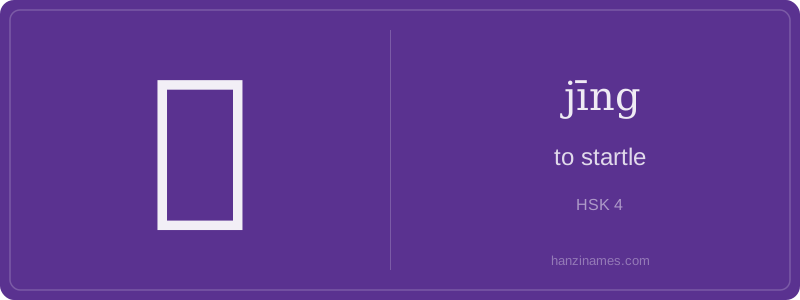
惊 is widely used in modern Mandarin in expressions like 惊喜 (jīng xǐ, 'pleasant surprise') and 惊讶 (jīng yà, 'surprise'), appearing daily in media headlines ('震惊!' — 'Shocking!'), customer service replies ('请勿惊慌' — 'Please don’t panic'), and psychological discourse. It’s central to the idiom 一鸣惊人 (yī míng jīng rén, 'to startle the world with one cry'), referencing the Chu State minister Sun Shu’ao, whose talent stunned the court—documented in the Zuo Zhuan (c. 4th century BCE).
The character evolved from seal script, where the left 忄 (heart radical) and right 京 (jīng, 'capital', phonetic component) combined to indicate a heart-racing reaction—akin to the visceral impact of entering an imperial capital for the first time. No oracle-bone form survives, but its structure reflects Han dynasty standardization, prioritizing semantic clarity over pictographic origin.
The character 惊 (jīng) embodies a profound cultural sensitivity to sudden shifts in inner equilibrium—reflecting the Confucian and Daoist emphasis on harmony, composure, and mindful awareness. In traditional Chinese thought, being startled isn’t merely physiological; it signals a rupture in qi flow or emotional balance, making it a diagnostic cue in medicine and ethics alike. This elevates ‘startle’ from reflex to relational event—tied to environment, social cues, and moral readiness.
Historically, 惊 appears in classical texts like the Classic of Poetry and medical treatises such as the Huangdi Neijing, where it describes both external shocks (thunder, ambush) and internal disruptions (fright-induced insomnia or palpitations). Its usage reveals how Chinese cosmology links psyche, body, and cosmos: a sudden noise doesn’t just scare you—it momentarily scatters your spirit (shen), requiring conscious recentering.
This worldview contrasts with Western individualistic interpretations of fear. Here, ‘startling’ is never purely personal—it ripples through relationships and responsibilities. A leader who ‘starts’ others risks losing trust; a student who ‘is startled’ by criticism may be seen as lacking cultivation. Thus, 惊 carries quiet ethical weight: mastery over startlement signifies maturity, self-discipline, and social attunement—a subtle but vital virtue in Chinese humanism.
Example Sentences
Common Compounds
Similar Characters — Don't Mix These Up
Your First Step into Chinese Culture: Get a Chinese Name
Every journey into Chinese begins with a name. Use our free Chinese name generator to create a meaningful, personalized Chinese name that fits you perfectly.
Get My Chinese Name →