丑
Character Story & Explanation
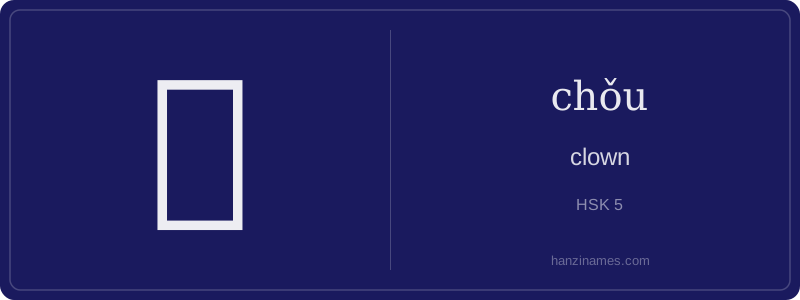
In modern Chinese, 丑 most commonly appears in 丑角 (chǒujiǎo, 'comic role')—a cornerstone of traditional opera (e.g., Peking opera), where performers use white-painted 'silly' facial patterns to portray clever fools, corrupt officials, or lovable rascals. It also appears in the 12 Earthly Branches (e.g., 丑年, chǒu nián, 'Year of the Ox') and in words like 丑闻 (chǒuwén, 'scandal'), where it conveys moral ugliness. Historically, 丑 was never a standalone word for 'clown' in classical texts; that usage crystallized in Ming–Qing theatrical manuals and folk performance troupes.
The character’s origin is documented: 丑 evolved from oracle-bone script —a pictograph resembling a bound person or knotted rope, representing 'obstruction' or 'constraint'. By the Warring States period, it standardized into the four-stroke form we know, losing its pictorial detail but retaining its phonetic and calendrical function. No verified oracle-bone inscription uses it for 'clown'—that meaning is purely post-classical.
As an archaeologist sifting through layers of oracle-bone inscriptions and early bronze script, I found no evidence that 丑 originally meant 'clown'—that sense emerged over two millennia later. Instead, excavated Shāng dynasty records (c. 1200 BCE) show 丑 as a *dìzhī* (Earthly Branch), the second in the 12-year zodiac cycle, linked to the Ox and associated with stillness, storage, and the northeast direction. Its earliest form resembles a stylized knot or bound object—perhaps symbolizing restraint or containment, fitting its calendrical role in marking winter’s depth.
The character’s radical is 一 (yī, 'one'), not because it signifies unity, but because early seal script standardized its top stroke as a horizontal line—replacing earlier variants with curved or forked heads. This simplification occurred during Qin standardization (3rd c. BCE), when clerical script reduced pictographic complexity. The four-stroke structure we use today reflects bureaucratic efficiency, not symbolic intent: a horizontal line, then three descending strokes forming a compact, grounded shape—echoing the Ox’s steady, earthbound nature.
By the Han dynasty, 丑 had solidified as both a temporal marker and a phonetic component in compound characters like 纽 (niǔ, 'knot') and 扭 (niǔ, 'to twist'). Its 'clown' meaning only appeared in late imperial vernacular literature—first in Ming dynasty opera scripts, where performers playing comic roles wore exaggerated makeup labeled 丑角 (chǒujiǎo). This semantic shift mirrors global theatrical history: from ritual mask to social satire, the 'clown' emerged not as folly, but as sanctioned truth-teller—using absurdity to expose hypocrisy, much like ancient Greek satyr plays.
Example Sentences
Common Compounds
Similar Characters — Don't Mix These Up
Your First Step into Chinese Culture: Get a Chinese Name
Every journey into Chinese begins with a name. Use our free Chinese name generator to create a meaningful, personalized Chinese name that fits you perfectly.
Get My Chinese Name →