倡
Character Story & Explanation
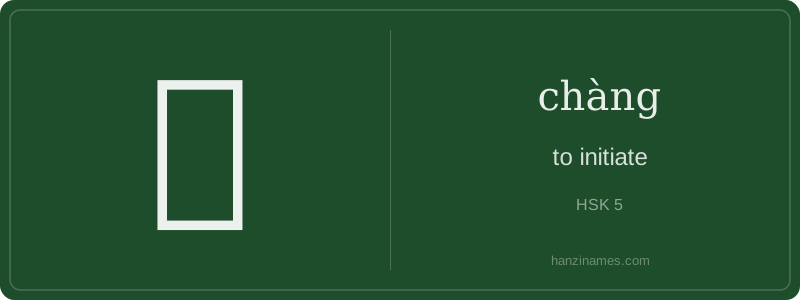
In contemporary China, 倡 appears frequently in official discourse and civil society contexts. The phrase 倡导绿色生活方式 (chàngdǎo lǜsè shēnghuó fāngshì)—'advocate for a green lifestyle'—is ubiquitous in municipal campaigns, appearing on subway ads, school curricula, and CCTV public service announcements since the 2015 National Ecological Civilization Strategy. It’s also central to HSK 5 vocabulary due to its prevalence in formal written Chinese.
The character 倡 is not pictographic; its earliest attestation is in bronze inscriptions from the Warring States period (475–221 BCE), where it already carried the meaning 'to initiate/proclaim'. Its right-hand component 昌 (chāng) originally meant 'prosperous, flourishing', reinforcing the idea that true initiation bears positive, expansive outcomes—verified by Shuowen Jiezi (100 CE) and modern paleographic studies.
Imagine a bustling community center in Chengdu, where a young NGO worker named Li Wei stands before a group of elders and volunteers. She’s just launched a new neighborhood recycling initiative—and her opening words are: 'We must chàng this effort together!' Her use of 倡 (chàng) isn’t just rhetorical; it signals leadership, agency, and collective responsibility. In Chinese, 倡 carries the weight of moral initiative—not merely suggesting, but courageously starting something meaningful.
Unlike passive verbs like ‘suggest’ or ‘propose’, 倡 implies action with conviction. It appears in formal speeches, policy documents, and grassroots campaigns—always tied to values like sustainability, education reform, or cultural preservation. Its radical 亻 (person) underscores that initiation is a human act: deliberate, relational, and ethically grounded. You won’t hear it in casual chat about weekend plans—but you will see it on banners at university forums or in government white papers.
The character’s ten strokes form a balanced structure: two vertical lines (the 亻 radical), then eight more strokes flowing rightward—mirroring how an idea spreads outward once initiated. Learners often confuse it with similar-sounding characters, but 倡’s uniqueness lies in its blend of urgency and legitimacy. When someone ‘chàng’ a movement, they don’t just speak up—they light the first match in a chain reaction of change.
Example Sentences
Common Compounds
Similar Characters — Don't Mix These Up
Your First Step into Chinese Culture: Get a Chinese Name
Every journey into Chinese begins with a name. Use our free Chinese name generator to create a meaningful, personalized Chinese name that fits you perfectly.
Get My Chinese Name →