伟
Character Story & Explanation
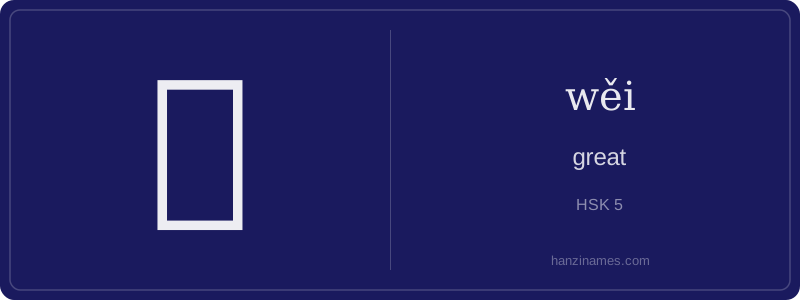
伟 is ubiquitous in modern Chinese public discourse: it appears in official titles like 伟大祖国 (wěidà zǔguó, 'Great Motherland') and core slogans such as 伟大、光荣、正确 (wěidà, guāngróng, zhèngquè — 'Great, Glorious, and Correct'), cementing its role in ideological and patriotic expression since the mid-20th century. It’s central to proper nouns including Mao Zedong’s title 伟大领袖 (wěidà lǐngxiù) and appears over 1,200 times in the People’s Daily archives from 2000–2023 in state-affirmed contexts.
The character evolved from the ancient form 偉 (with radical 亻 + 韋), where 韋 originally meant 'tanned leather' (a symbol of strength and resilience in early texts) — a documented semantic component in Shuōwén Jiězì (121 CE). Though simplified to 伟 in 1956, its meaning remained anchored in moral grandeur, not physical size alone.
The Chinese character 伟 (wěi) carries a rich semantic weight far beyond the simple English gloss 'big'. While it does denote physical or numerical largeness, its primary modern usage centers on moral and social magnitude — greatness in achievement, virtue, or historical significance. It evokes reverence and admiration, often applied to leaders, milestones, or ideals (e.g., 伟大领袖 'great leader'). Unlike neutral size terms like 大 (dà), 伟 implies exceptional, praiseworthy scale that inspires awe.
In cultural context, 伟 resonates strongly with Confucian and socialist values emphasizing contribution to collective welfare. It’s frequently used in formal, elevated registers — political speeches, history textbooks, and commemorative language — where 'bigness' is inseparable from ethical stature and public impact. This contrasts with Western notions where 'greatness' may emphasize individual genius or charisma more than service-oriented legacy.
Comparatively, English 'great' shares 伟’s dual capacity for literal and figurative use (e.g., 'a great wall' vs. 'a great person'), but 伟 rarely appears in casual speech or commercial contexts (unlike 'great!' as an exclamation). Its register is consistently solemn and institutional. In translation, substituting 'big' risks flattening its honorific gravity; 'magnificent', 'illustrious', or 'epoch-making' better capture its contextual nuance when describing people or events.
Example Sentences
Common Compounds
Similar Characters — Don't Mix These Up
Your First Step into Chinese Culture: Get a Chinese Name
Every journey into Chinese begins with a name. Use our free Chinese name generator to create a meaningful, personalized Chinese name that fits you perfectly.
Get My Chinese Name →