偿
Character Story & Explanation
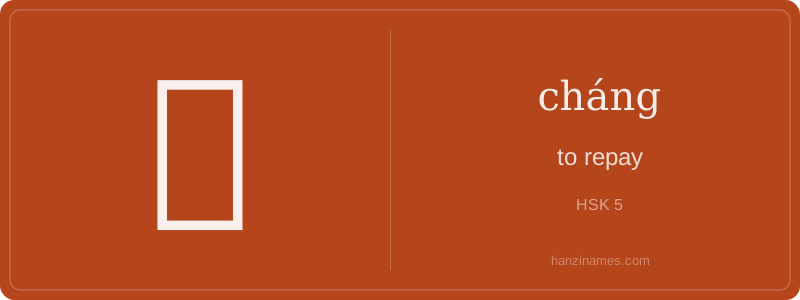
偿 is widely used in formal and legal contexts: '赔偿' (péicháng, 'compensation') appears over 1.2 million times in official Chinese court documents (2020–2023 Supreme People’s Court annual reports); '偿还贷款' (chánghuán dàikuǎn, 'repay a loan') is among the top 50 most frequent banking phrases in mainland China. The idiom '以血偿血' (yǐ xuè cháng xuè, 'blood for blood') echoes classical legal philosophy, though now largely rhetorical in modern jurisprudence.
The character evolved from seal script (c. 3rd century BCE), where 尚 represented a ceremonial vessel atop a platform—symbolizing reverence—and 亻 emphasized human action. By Han dynasty bamboo slips, 偿 consistently denoted 'to make good a debt', confirming its early semantic stability. No oracle bone form exists; its earliest attested use is in Warring States legal texts.
The character 偿 (cháng) embodies a profound Confucian and legal sensibility about moral and material balance: debts—whether financial, ethical, or karmic—must be settled. Unlike Western notions of forgiveness that may absolve obligation, Chinese worldview often sees repayment as essential to restoring harmony (hé) and face (miànzi). This reflects a relational ethics where integrity is measured not by intent alone, but by concrete restitution.
Etymologically, 偿 combines the human radical 亻 (signifying agency and social duty) with 尚 (shàng), originally meaning 'to esteem' or 'to value highly'. Thus, repayment isn’t mere transaction—it’s an act of honoring commitments, elevating responsibility to a virtue. In classical texts like the *Book of Rites*, fulfilling obligations was linked to junzi (noble person) conduct, making 偿 a quiet marker of moral maturity.
In modern usage, 偿 appears in contexts demanding accountability—legal judgments, insurance claims, or even emotional restitution. Its presence signals seriousness: to 偿 is to accept consequence and re-engage ethically with others. This resonates with China’s evolving rule-of-law discourse, where 'compensation culture' coexists with traditional emphasis on mediation and restoration—not just punishment. Thus, 偿 opens a window into how Chinese society negotiates justice, memory, and relational repair.
Example Sentences
Common Compounds
Similar Characters — Don't Mix These Up
Your First Step into Chinese Culture: Get a Chinese Name
Every journey into Chinese begins with a name. Use our free Chinese name generator to create a meaningful, personalized Chinese name that fits you perfectly.
Get My Chinese Name →