册
Character Story & Explanation
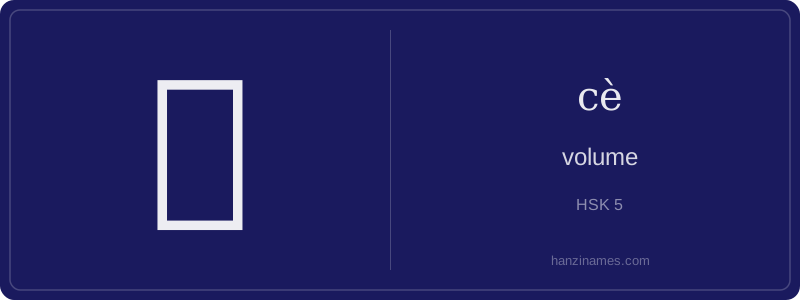
In modern China, 册 appears ubiquitously in administrative and educational settings: students receive 教科书一册 (jiàokēshū yī cè, 'one textbook'), libraries catalogue titles by 册, and tax authorities issue 纳税证明一册 (nàshuì zhèngmíng yī cè, 'one tax clearance certificate'). It’s standard in official documents — e.g., the National Bureau of Statistics publishes annual statistical yearbooks titled 中国统计年鉴 (Zhōngguó Tǒngjì Niánjiàn), where each edition is counted as 一册. Common idioms include 万卷书,千册文 (wàn juǎn shū, qiān cè wén), highlighting scholarly depth.
Historically, 册 originated as a pictograph in bronze inscriptions (c. 11th–3rd century BCE) depicting bamboo slips bound between two wooden covers — clearly visible as two outer vertical strokes (冂) with inner horizontal and dot-like knots. This documented form reflects actual Warring States–era bookmaking practices confirmed by archaeological finds at sites like Guodian and Mawangdui.
The character 册 (cè) is a deceptively simple yet historically rich symbol for 'book' — but not just any book. It evokes ancient Chinese bamboo or wooden slips, bound together with cord into a scroll-like volume. Its five-stroke form — two vertical lines enclosing a horizontal stroke and two dots — visually echoes stacked, tied strips. As a radical component (冂), it anchors characters related to enclosure or containment, reinforcing the idea of a bound, organized unit of text.
Unlike modern Western books, early Chinese 'books' were physical objects requiring careful handling: fragile bamboo slips weighed kilograms and demanded storage in lacquered boxes. The character 册 thus carries connotations of authority, record-keeping, and official documentation — from imperial edicts to land deeds. Even today, it appears in formal contexts where weight and legitimacy matter, like government registers or academic publications.
This character bridges antiquity and modernity: while rarely used alone in speech (people say 书 shū for 'book'), 册 thrives in compound nouns denoting structured, authoritative texts — textbooks, catalogs, ledgers. Its presence signals seriousness and systemization. Learning 册 opens a window not only into Chinese literacy but also into how knowledge was physically embodied, preserved, and legitimized across millennia — a quiet testament to China’s enduring bibliographic culture.
Example Sentences
Common Compounds
Similar Characters — Don't Mix These Up
Your First Step into Chinese Culture: Get a Chinese Name
Every journey into Chinese begins with a name. Use our free Chinese name generator to create a meaningful, personalized Chinese name that fits you perfectly.
Get My Chinese Name →