冠
Character Story & Explanation
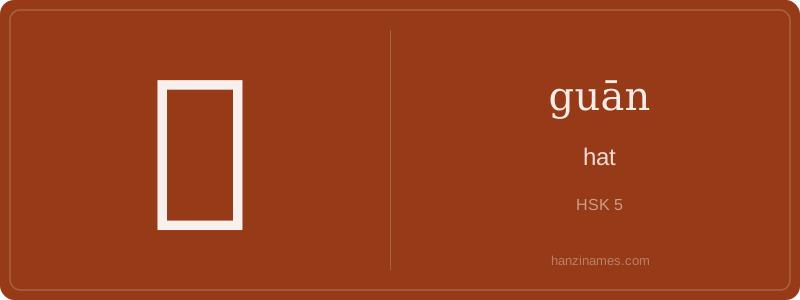
In modern Chinese, 冠 appears daily in news headlines (e.g., ‘冠亚军’ — champion and runner-up), sports reports (‘夺冠’ — win the championship), and formal titles (‘冠名权’ — naming rights). It’s central to idioms like ‘怒发冲冠’ (hair standing on end, making one’s hat rise—a vivid image from Sima Qian’s *Records of the Grand Historian*), and the HSK-5 idiom ‘衣冠楚楚’ (neatly dressed, literally ‘hat-and-robe elegant’).
The character’s seal script form clearly depicts a hat (冖) over ‘head’ (元), documented in bronze inscriptions from the 9th century BCE. Unlike speculative oracle-bone reconstructions, this origin is verified in excavated Warring States bamboo slips and the *Shuōwén Jiězì* (121 CE), which defines 冠 as ‘a covering for the head used in rites’—confirming its ritual function from earliest attestation.
Unearthing this character feels like brushing dust from a Zhou dynasty bronze ritual vessel—its form reveals layers of meaning. The radical 冖 (a covering) crowns the structure, while 元 (‘head’ or ‘first’) anchors it below, suggesting something placed upon the head. Early seal script shows a clear pictographic lineage: a stylized hat atop a human head. This wasn’t mere apparel—it marked rank, rite, and responsibility in ancient courts and ancestral ceremonies.
The dual pronunciation guān/guàn mirrors its semantic duality: as a noun (guān), it denotes physical headgear—ceremonial caps, military helmets, even metaphorical 'crowns' of achievement. As a verb (guàn), it signifies the act of bestowing honor, as in ‘crowning’ a ruler or ‘topping’ a list. This grammatical bifurcation is rare and deliberate—language encoding social hierarchy into phonology itself.
Archaeological inscriptions confirm that by the Warring States period, 冠 was already standard in texts describing rites of passage—most notably the Guānlǐ (capping ceremony), where a young nobleman received his first adult cap at age 20, symbolizing moral maturity and civic duty. The character thus functions not just as lexeme but as cultural artifact: a lexical fossil preserving Confucian pedagogy, bureaucratic protocol, and sartorial semiotics across millennia.
Example Sentences
Common Compounds
Similar Characters — Don't Mix These Up
Your First Step into Chinese Culture: Get a Chinese Name
Every journey into Chinese begins with a name. Use our free Chinese name generator to create a meaningful, personalized Chinese name that fits you perfectly.
Get My Chinese Name →