影
Character Story & Explanation
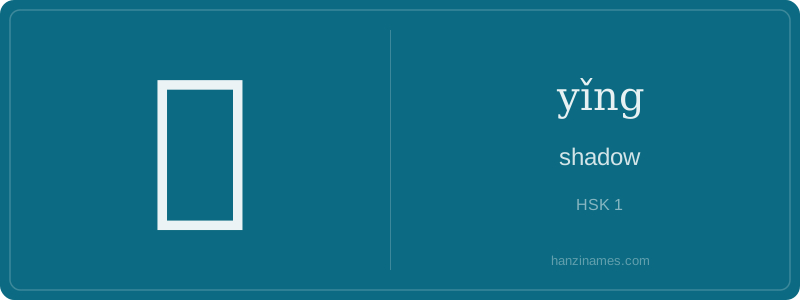
影 has been used for over two millennia to mean 'shadow' — confirmed in classical texts like the Zhuangzi (4th c. BCE), where 'chasing shadows' (逐影 zhuí yǐng) symbolizes futile pursuit. Today, it’s ubiquitous: 影片 (yǐngpiàn, 'film'), 照片 (zhàopiàn, 'photo', literally 'light picture'), and 影响 (yǐngxiǎng, 'influence' — originally 'shadow effect'). The phrase 杯弓蛇影 (bēi gōng shé yǐng, 'cup-bow snake shadow') is a famous idiom from the Han dynasty describing baseless fear.
The character’s structure reflects its origin: the top 日 (rì, 'sun') + 景 (jǐng, 'scenery, light') — historically, 影 was a variant of 景, emphasizing light-caused visual phenomena. No oracle-bone form survives, but bronze inscriptions show early use meaning 'shadow cast by sunlight' — a documented, physical phenomenon central to ancient Chinese astronomy and timekeeping.
Hello, learners! The character 影 (yǐng) is a Level 1 HSK word — meaning it’s one of the most essential characters you’ll encounter early on. Though its basic English gloss is often given as 'picture', that’s actually a simplification: 影 fundamentally means 'shadow' or 'reflection', and by extension, 'image' — like a photo, film, or silhouette. It’s not about painted pictures (that’s 画 huà), but visual traces left by light and form.
Notice its radical 彡 (shān), which appears in characters related to appearance, decoration, or traces — think of brushstrokes, patterns, or shimmering effects. This hints at 影’s core idea: something visible but insubstantial, fleeting, or projected. You’ll see it everywhere — from movie theaters (电影院 diànyǐngyuàn) to smartphone cameras (拍照 pāizhào, where the photo itself is a 影像 yǐngxiàng).
Don’t confuse 影 with similar-sounding words like 音 (yīn, 'sound') — they’re unrelated in meaning and writing. Practice writing it with its 15 strokes in order: start with the top-left 'sun' component (日), then build down through the 'scissors' shape (彐), and finish with the three-stroke 彡 radical on the right. Each stroke reinforces the idea of layered, light-based imagery.
Example Sentences
Common Compounds
Similar Characters — Don't Mix These Up
Your First Step into Chinese Culture: Get a Chinese Name
Every journey into Chinese begins with a name. Use our free Chinese name generator to create a meaningful, personalized Chinese name that fits you perfectly.
Get My Chinese Name →